Gestapo
Jackdaws
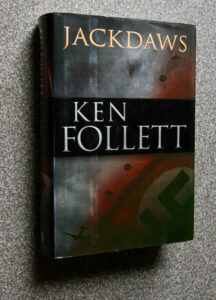 Having enjoyed Ken Follett’s novel Whiteout way more than expected, I raked another one from the back of my shelves: Jackdaws. A hefty 450 page hardback so not for the faint-hearted. It was well worth the effort.
The story is set in the dangerous final days of the Second World War. D-day is approaching and for one of Britain’s most effective operatives in northern France, senior agent Major Felicity (Flick) Clairet, the stakes have never been higher. She’s responsible for sabotage behind enemy lines and is no stranger to fear and danger, but she’s ruthless, clear-thinking, and paranoid about security; one of the survivors.
The centre of the proposed action is a large telephone exchange sited in a beautiful chateau near Reims which the Germans have enlarged to provide connections between the French and German communication systems, and a base for the Gestapo regional headquarters. It’s of enormously significant strategic importance; if it were destroyed, German communications would be crippled.

But when Flick and her husband, Michel – a Resistance leader – try a direct head-on assault, things go horribly wrong. On this occasion the intelligence supplied by MI6, had been inaccurate. Her team is destroyed, lives are lost, her husband is missing, confidence is temporarily shaken. But she remains resolute in her determination not to let the sacrifices be in vain.
Time is not on her side. She assembles a small group of women: a flirt, a murderess, a safe-breaker, a female impersonator, two aristocrats, one awkward, the other entitled – all unprofessional, but each with certain skills Flick needs. Code-named Jackdaws, these six women will attempt a daring infiltration under the very noses of the Germans, impersonating cleaning staff. An agents’ course normally takes three months; Flick has just two days to teach this motley band of women basic security rules: how to parachute, how to use weapons, and how to kill people without making a noise. Then they will be parachuted into France to blow up the telephone exchange.

Terrific tension is created by parallel accounts of the British team preparing to take out the telephone exchange and the German Major Deiter Franck infiltrating the French Resistance, as the countdown days are ticked off one by one. The descriptions of torture techniques, and the brutality of war, are both vivid and sickening, but the enormous courage of those who worked in enemy territory is breathtaking. It’s a shockingly mesmerising and totally gripping tale, bringing with it a fearful awareness of the price that was paid for the peace we take for granted.
Exactly 50 women were sent into France as secret agents during WWII; of these 36 survived. The other 14 gave their lives in service. This book is dedicated to them.
Alone in Berlin
Having just read a book about the German side of the Second World War and posted a review last week, I segued smoothly into another one about German resistance to the Nazis, which I bought at the same time.This one is Alone in Berlin by Hans Fallada (translated by Michael Hofmann).
The author’s own biography reads like an exaggeration but he is generally accepted as one of the foremost German writers of the twentieth century. However, after allegedly writing this book in twenty-four days, he died before Alone in Berlin was published, the victim of his own abuse of alcohol and drugs, but not before he had informed several relatives that this was a ‘great novel’. It was in fact a reworking of a real-life case to which Fallada had been given access. His contention in the book is that morality under Nazi rule was not measured by the size of the effort made to stand up against tyranny and atrocity, but by doing something, rather than simply capitulating and accepting evil. But as the afterword explains, though ‘there was substantial and heroic resistance to the Nazi regime at all levels of German society, from aristocratic officers in the army to brutalized inmates of concentration camps … this resistance was unsuccessful, in the sense that the regime was destroyed by the foreign armies which conquered it rather than by internal rebels who overthrew it.’

The book recounts numerous small acts of defiance and rebellion on the part of many anti-Nazi dissidents, but the main story centres on the Quangels. Otto Quangel is an insignificant taciturn emotionally-stunted man working as a shop foreman in a furniture factory (now given over to producing coffins) and living with his wife Anna in a run-down tenement block in Berlin. When his only son is killed in battle during the invasion of France, he hatches a determined plan to fight back against this unjust war that has robbed them of their family and future: he will write and secretly distribute postcards, decrying the government, urging civil disobedience and workplace sabotage. It’s an unspectacular and unsophisticated effort, limited to a small area, but as Anna says, whether acts are big or small, no one could risk more than his life. The main thing was: you fought back in whatever way you could; tried to stay decent, have no part in the evil being perpetrated and promoted all around you. Otto tries to be vigilant, not get caught, firm in the conviction that the longer you could fight, the longer you were being effective against brutality; there was no value in dying early. Besides, he wanted to be there when the regime fell, to be able to say: we were there; we were fighting our own war.
Inspector Escherich of the Gestapo, immediately deduces the writer of the anonymous propaganda is a poorly educated workman who recently lost his only son. Give him time, and he’ll reveal more details about himself. It just requires patience and alertness and he will hunt down ‘the Hobgoblin’. But as the months go by he develops grudging admiration for this wily person whose postcards arrive in his office every week.
Two years on, 233 cards and 8 letters have reached the Gestapo. Escherich has been removed and tortured; Inspector Zott has taken over the investigation. Zott’s methodical approach leads him to very similar conclusions to his predecessor but he is convinced the postcard writer works with the city trams. This certainty allows the Quangels to avoid capture the first time they fall under suspicion, but then Otto makes a fatal mistake. And after a long patient vigil, the now-reinstated Inspector Escherich pounces, determined not to let any irregularities in procedure abort his moment of glory. By this time his painstaking mapping shows 259 cards have been handed in; and he is confident in his profiling of the sender.
But Quangel is appalled when he learns not only that a mere 18 cards have been left in circulation, but that his actions have terrorised the very people he wanted to free. ‘I never wanted that! I never thought that would happen! I wanted things to get better, I wanted people to learn the truth, so that the war would end sooner and the killing stop – that’s what I wanted! I didn’t mean to sow terror and dread, I didn’t want to make things worse than they are already! Those wretched people – and I made them even more wretched!’
The Inspector points out he didn’t stand a chance; he is a gnat pitting himself against an elephant. ‘You, an ordinary worker taking on the Führer, who is backed by the Party, the Wehrmacht, the SS, the SA. The Führer, who has already conquered half the world and will overcome the last of our enemies in another year or two? It’s ludicrous!’

Nevertheless, it’s Quangel who emerges the moral victor. When he points out to the Gestapo officer, ‘You’re working in the employ of a murderer, delivering ever new victims to him. You do it for money; perhaps you don’t even believe in the man. No, I’m certain you don’t believe in him’ – it’s the inspector’s gaze that is lowered. He has become Otto’s only convert.
As one dissident tells a rather complacent colleague who seems content in his personal happiness with his wife and coming baby, ‘You’re robbing mothers of their sons, wives of their husbands, girlfriends of their boyfriends, as long as you tolerate thousands being shot every day and don’t lift a finger to stop the killing. … your apathy made it possible.’ Real decency demands protest. And somehow the quiet dignity and courage of this ordinary couple, even under severe provocation in prison, convey a powerful message.
It’s a substantial tome and the English is a tribute to the translator. The rather unusual switching of tenses, points of view and perspectives, owes more to the author’s style than the translator’s, I suspect. But, to my surprise I found it held my attention effortlessly in spite of the slow pace, minimal action and limited plot. Oh, and I had to smile at Otto’s description of reading: ‘something superfluous that only high-up people went in for, people who did no proper work.’ Hmmm!