The clock is ticking …
Big week this week. Tomorrow (29 November) Westminster Parliament will debate and vote on the Assisted Dying Bill in England and Wales – or more properly The Terminally Ill Adults (End of Life) Bill.
NB. Scotland has formulated and debated its own version of the legislation for assisted dying which is currently being examined minutely by Holyrood’s Health Committee, although they will be unable to proceed to formally legalising assisted dying without authority from Westminster.
It’s an emotive and conflicting topic, and I can see arguments for both sides. But it’s by no means as straightforward as some suggest. Of course, no one wants people to die horrible painful undignified deaths, but is medically assisted dying the answer?
Proponents of the proposed new bill claim that safeguards will be stringent; in essence:
- Patients must be over 18, registered with a GP for at least 12 mths
- 2 independent doctors must be involved in the decision
- They must ensure there is no coersion or pressure, the decision is voluntary and informed and a settled wish, and the patient is fully aware of other options, eg palliative care, and that they can change their mind at any time
- An expert should assess mental capacity
- The patient must declare their wishes for death on two separate occasions, witnessed and signed
- A high court judge must approve the case
- The Chief Medical Officer must monitor and report on how legislation works in practice.
 Stringent …? Ahem. That’s just how such bills were introduced in countries like Netherlands, Canada, Belgium. Within a few short years the safeguards had already been eroded. Scary statistics and reports show a huge escalation in numbers dying this way, and they include couples choosing to die together, young people with autism or anorexia, people who are depressed or lonely but otherwise well, young children. Indeed in the Netherlands plans are in process to allow the healthy elderly (>75) to be helped to die if they undergo 6 months of counselling.
And there’s another stumbling block which hasn’t had much airing. Human rights barristers and legal scholars have warned that slippage is not just likely but inevitable, because to deny other groups of people access to assisted dying would be seen to contravene the European Convention on Human Rights, and be discriminatory. So initial qualifying conditions are sure to expand here as they have done elsewhere regardless of the care taken with framing the law.
Even if all the intentions are really sincere, there are issues too with the criteria themselves. We all know medical prognoses can be wildly wrong. Who can really confidently predict death will occur within six months? Senior practitioners and experts in palliative care agree, it’s impossible until very much closer to the end than ‘months’, and research has verified this fact. Then, who is going to train doctors in this additional work? How will the medical world deal with doctors whose consciences don’t allow them to be party to this service, even referring patients on? Are there going to be enough high court judges available and willing to add this task to their existing load? Prominent legal experts have already questioned the role of the judiciary in what is essentially a medical matter.
Then there’s the whole question of viable alternatives. Hospice care is an amazing service and certainly one I personally support wholeheartedly. It focuses on living well right to the end. It’s sensitive to all aspects of a person’s well being – physical, emotional, spiritual, psychological. It includes caring for the whole family. What’s more, it is already assisting people to die humanely and compassionately. But – and it’s a colossal but – we all know that palliative care is woefully underfunded and its availability seriously limited. Only a small fraction of its total cost is paid for by the Government. In order to survive at all it must rely heavily on fundraising, and the escalating cost of living crisis has meant the generous public now have less to donate. As a consequence of this proposed new legislation, it’s feared governmental support will be reduced further if hospices deline to sign up to ending lives in line with the new bill.
Another avenue that’s under-utilised is that of Advance Directives or Living Wills, legally binding documents that state a person’s wishes for the future in certain circumstances or conditions where they might not be able to convey those choices for themselves. Withdrawing or withholding treatment is legally permissible already. However, only a small proportion of the population fill out such an expression of their wishes.
Should we then return to the pre-Shipman era where doctors could give sufficient opiates to end pain and distress, even if the double effect was to hasten death? This was generally regarded as a kind and compassionate response to intractable suffering before suspicion clouded the supposed intentions of healthcare providers.
This is by no means an exhaustive discussion of the issues, but hopefully underlines the need for huge care in deciding on this matter while there is still time. As one doctor put it: It’s a dangerous trajectory from which there can be no return.
A favourite author revisited
Having struggled through A Year of Magical Thinking, I needed something gripping to refresh the parts literary prose simply doesn’t reach for me. And what better distraction than one of my favourite authors, Robert Goddard. I keep a row of his novels for just such moments of rescue.
 As luck would have it, Set in Stone begins with reflections on a death! And instantly it resonates with me far more profoundly than Magical Thinking did. Anthony Sheridan’s wife Marina is found at the foot of a cliff not far from their home in Cornwall. The authorities question whether it was a suicide, but Tony knows Marina was in robust mental health and assumes she was so caught up in enjoying the flowers that she trod unwarily near the cliff edge. She was, after all, in her personal element, having recently moved to the house and the county of her choice and dreams. The prologue perfectly captures the mood and style:
I can’t see you, Marina. I can’t hear you… More than anything I love you. I will always love you. … It’s as simple and desolate as that. I don’t need to chase your ghost. It’s here, at every moment, beside me. It’s almost tangible. But not quite. You’ll always be just out of reach. I can’t touch you. Ever again.
But I can talk to you. And maybe, just maybe, you can listen. I wish I could tell you a different story, though. I wish I could tell you your death was just a single outbreak of meaningless misfortune. I wish I could wipe away the events it set in motion and have you back, alive and contented, to love and be loved. But wishing is all it comes to. It changes nothing. There is only one story I can tell you. And this is it.
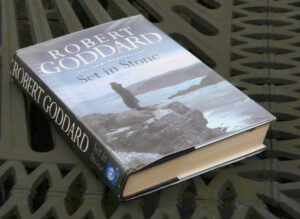 And the book is written as if he’s speaking to her. It’s a powerful technique in the hands of a master.
Following Marina’s death, Tony is bereft. and instantly puts the house on the market, before going to stay with Lucy, Marina’s sister, and her husband Matt. He’s slightly taken aback by her likeness to Marina especially when she wears some of her sister’s favourite clothes. But he’s also intrigued by Otherways, the architect-designed circular house they have recently bought, with its own moat and lake, complete with a macabre history: a woman was murdered in the garden; her husband was hanged for the crime; and her brother-in-law defected to Russia after spying for them for years. What’s more, Lucy has recently befriended the now-elderly sister of the murdered woman who was herself briefly engaged to the spy.
Little by little Tony is drawn into the secrets and horrors of this house. The more he learns the deeper he gets into questioning everything related to it; even exactly how Marina died. She and Matt and Lucy were all keeping secrets he knew nothing of. His own personal life spirals into chaos. He has vivid dreams which subsequently mysteriously materialise in real life. When Matt goes off on business for a few days, he and Lucy, alone together in Otherways, are drawn together intimately as if this was always preordained. He forsees accidents and deaths. And he becomes increasingly conscious of a haunting feeling of other presences in this cursed house. Eventually, wracked with guilt, he leaves Otherways before Matt returns, but it doesn’t leave him, and he begins to follow up on links to its previous owners and their secrets with horrific consequences, putting his own as well as others’ lives in danger.
Goddard is a master at creating suspense and unravelling a multi-layered story. In this book he weaves together complex political intrigue, spine-chilling paranormal phenomena, and psychological depths that keep us guessing to the last page. Just whose version of events is the true one? A brilliant diversionary read.
The Year of Magical Thinking
 Right now several people dear to me are grappling with great loss – both present and impending. Merely being with them focuses the mind critically and changes one’s perspective. And it drew me to a book I had put off reading till the right time: The Year of Magical Thinking by Joan Didion. First published in 2005, it won the National Book Award (for books published in the USA) that year. But it comes into the ‘literary genre’ bracket which requires a certain level of determination to tackle and persist with.
On 30 December 2003, John Gregory Dunne and Joan Didion (both American writers) had been to visit their newly-married and only daughter, Quintana, who was lying unconscious in an ICU bed suffering from pneumonia and sepsis. Once home, they lit a fire, cooked an evening meal, and while still at the dining table, John simply keeled over and died. Thirty-one days short of their fortieth anniversary. There was no warning; no premonition. Joan dialled for an ambulance and the paramedics tried for 45 minutes to restart his heart but to no avail.
You sit down to dinner and life as you know it ends.
In a heartbeat.
Or the absence of one.
Joan struggled to believe it had happened. She fantasised that he was coming home. She tried to stall the obituaries because they made it too apparent that others believed he had gone. She couldn’t get rid of his shoes because he would need them when he returned.
Then less than three months after her father’s death, Quintana collapsed on the airport tarmac having suffered subdural bleeding. By the time she arrived at the Los Angeles hospital her midbrain was compressed, she was bleeding from an artery in her brain, and a large haematoma had formed. Emergency surgery was performed. Her future was again uncertain.
This book is Joan’s ‘attempt to make sense of the weeks and then months that cut loose any fixed idea I ever had about death, about illness … about marriage and children and memory … about the shallowness of sanity, about life itself’.’
She found a focus in her grief by initially concentrating on Quintana and her goals and hazards. She actively avoided anything that might trigger painful memories or powerful reactions, summarily banishing wayward thoughts. She avoided acts which reinforced the reality of John’s absence.
Grief was passive. Grief happened. Mourning, the act of dealing with grief, required attention.
 Her analytical approach is certainly not a universal response to great loss. The searing emotion, the rawness, are somehow given a respectable, a polite, veneer. But from a distance her reflections hold a form of truth and wisdom that perhaps some will relate to. Really it boils down to the reality that this literary style is not for everyman. Years earlier Joan had been somewhat disheartened when one of her other books was adjudged to have the potential to do well ‘among adults with sixteen-plus years of education‘. In my humble opinion The Year of Magical Thinking would probably appeal to a similar demographic.
However, reviewers have been fulsome in their praise:
There are no bogus resolutions. Questions are unanswered, huge tensions unresolved, but somehow you’re consoled. Clarity …, honesty …, powerful …, moving …, haunting …, tender …, restrained …
Yes, probably; but perhaps just not easily accessible or relatable.
(Joan Didion died in 2021 aged 87)
The Girl Behind the Gates
A couple of weeks ago a friend of mine handed me a book, The Girl Behind the Gates, (2020) with a trademark smile but no explanation; just ‘I’d love to know what you think.’
 I’m instantly intrigued. First, by the author, Dr Brenda Davies, who’s a consultant psychiatrist, author, broadcaster, spiritual teacher and Principal of the Brenda Davies International School of Healing and Spiritual Development. Impressive, huh?
Second, by the blurb which tells me this is Davies’ first novel, and it’s based on the true story of a young woman cut down in her prime who’s eventually found in a psychiatric institution and slowly helped to overcome her past.
The fictionalised account takes us back to 1939. Seventeen-year-old Nora Jennings has led a charmed life, secure and happy, musically gifted, with bright prospects. Then one night of passion with her beloved cousin leads to catastrophic consequences. When her parents learn of her pregnancy, her father beats her savagely with a leather belt, before summoning their family doctor, priest and the senior doctor who directs the dreaded Hillinghurst Hospital, the very name of which is garlanded with shame and fear and inherent malevolence.
When it’s discovered that not only is Nora pregnant, but that she tried to abort the child using quinine and to cut her own wrists, the situation develops layer upon layer of criminality and moral unacceptability. All three acts are ‘mortal sins’. This is the era of the Mental Deficiency Act of 1913 after all. Nora, deemed a ‘moral imbecile’, or under the 1927 definitions a ‘moral defective’, poses a threat to others (terms only abolished in 1959!). She must be strictly controlled and segregated along with criminals, alcoholics, prostitutes and unmarried mothers who carry the same label. Sympathising with this disgraced family though he may, their family doctor can do nothing to protect her or he too will be imprisoned for ‘aiding and abetting’ criminal offences.

Under cover of darkness Nora is taken from her home and family and sectioned, locked away in the feared Hillinghurst Hospital. A young innocent with no diagnosis beyond a pregnancy out of wedlock.
‘We’re all here to help you get well’, the young doctor in charge of her care promises.
‘It would be best for everyone if you consider your family dead’, the second more senior doctor advises. ‘You’ve been a wicked cunning girl, and here you’ll learn to live a better life ..’
It’s horrifying to read of the barbaric treatments that were used in those days. Bad enough that they were applied in cases of real mental illness in a well-intentioned effort to cure; absolutely scandalous applied to this young sensitive girl who is simply trying to survive. Even the archaic un-pc-by-our-standards language sends shudders down the spine.
What’s more, those paid to care for the inmates inflict malicious cruel acts against her; and anyone showing compassion or kindness is punished or even dismissed. Nora endures both physical and sexual abuse, isolation, visitors are deterred, letters are withheld, humiliation is piled on top of scorn. When she gives birth to the baby, she’s denied even sight of her, and the child is left on a cold slab to die. Utterly bereft, Nora suffers a majorly powerful grief reaction but still clings to the hope that her baby has been adopted and one day she will seek and find her. She only learns of her death when she stumbles upon a patch of baby graves in the grounds and finds Angela’s marker.
Fast forward forty-two years to 1981, and Nora is discovered by psychiatrist Dr Janet Humphreys totally institutionalised and withdrawn in a back ward. Patiently and with great sensitivity, Janet starts to work with her to overcome her isolation and help her rediscover what it is to live freely. The account gives insights into the delicacy of such a task and the peaks and troughs that Janet much negotiate. And all the while the doctor is herself dealing with her own troubled past and broken relationships.
It’s a magnificent and heart-rending book, and despite the shocking revelations of life in a mental facility in the past, it’s ultimately a tale of triumph of good over evil, of hope over despair, and love over punishment.
Some you win …
Ahah, just when I’d got back together with Jodi Picoult and her clever novel, Mad Honey (reviewed in a post three weeks ago), the balloon bursts again. Big time.
I ordered another of her books with high hopes, and settled down to a good read. But alas, t’was not to be. No matter how fast I knitted, no matter how much I applied my mind! Reminded me yet again that each book has to stand alone, and just because I’m entranced by one doesn’t mean I’ll love everything by that author.
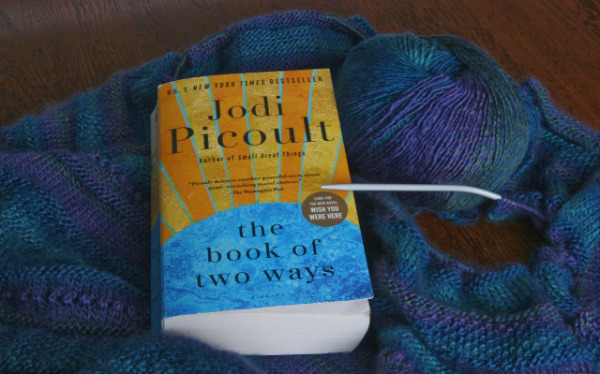
The Book of Two Ways tells the story of Dawn McDowell/Edelstein at two points in her life. The first is a young Dawn, a post grad Egyptologist working amongst the tombs of the Pharaohs and rulers, falling in love with an English earl in the dirt of the necropolis. The second, fifteen years later, is Dawn when she’s a mother and death doulah, accompanying clients on their last journey on earth, briefly returning to the site of the Egyptian excavations, reconnecting with the man who stole her heart.
As ever the author has done a phenomenal amount of research and background work. She’s even included hieroglyphs and ancient drawings in the book – how, I’ve no idea! But in spite of my admiration for her diligence, I struggled.  I found the main character annoyingly hypocritical and dysfunctional. To my mind there was way, way too much technical detail about quantum physics and ancient Egypt and its languages and customs, for the purposes of a novel. Though I’m certainly particularly interested in terminal care and its management, I found the detail even here excessive and off-putting. I had to take frequent breaks and steel myself to persist to the end. As so often with Picoult, the psychological musings and insights didn’t fit with my own experience of ordinary people and how they think. And finally we don’t get to know Dawn’s decision about the two men in her life … ever! The very thread that kept me reading the last seventy pages!! The balloon I mentioned at the beginning deflated with an annoying splutter.
Shame. I wanted to get lost in it, but couldn’t.
Lucy Letby: The New Evidence
Given that I reported on the conviction for murder of neontal nurse Lucy Letby when it happened, I feel morally obliged to also draw attention to the serious questions now being raised about her guilt or innocence. Questions which have grown from whispers on social media platforms to issues being considered by the highest legal circles in the land.
 I’m sure you’ll remember the haunting pictures and harrowing stories of unexpected deaths in a Neonatal Unit and the ‘evidence’ that pointed to Lucy Letby being the one constant factor in each case. And who could feel unmoved by the despair and distress of the parents coming to terms with the notion that their tiny infants had been murdered; murdered by someone they trusted to protect and care for them. Or indeed who could forget the finality of that prison door slamming behind a woman in her 30s for the rest of her life, a woman who had supposedly chosen a career of care and compassion.

For some time the papers have been drip feeding information that puts a giant questionmark over the case. And recently Channel Five aired a sobering programme presenting the accumulating evidence that seems to cast grave doubt on the safety of that judgement. Lucy Letby: The New Evidence, brings together the testimony of a number of acredited experts and important information that appears to say that the case against her was almost entirely circumstantial; that evidence presented was misleading, wrongly interpreted or not scientifically based. Even the rota placing Lucy at the centre, and the doorswipe data, that seemed compelling at the time, are not sound, we’re told. A deadly superbug was around in the hospital at the time; there were santitation issues; her nursing colleagues were warned not to witness for her; no medical experts were brought in for the defence …
The Crown Prosecution Service have admitted post-conviction that the evidence brought during the trial was untrustworthy. And now major investigations are ongoing to unpack the whole story. Is the nurse I reported as a murderer, in fact innocent? I devoutly hope that in time the truth, the whole truth, and nothing but the truth will be revealed.
Dare I?!
I’m not sure whether I dare raise this topic again on this forum, but here we are facing yet another parliamentary debate on this ultra-sensitive topic. Labour MP * Kim Leadbeater‘s Private Members’ Bill on assisted dying was tabled yesterday, on October 16, with a free vote scheduled for 29 November. There’ll be much debate and argy-bargy between now and then, so I’m getting my tuppence worth in at the outset.
 Over the past sixteen years, since publishing Right to Die, in 2008, I’ve periodically revisited this topic on my blog, often with an apology, as regular visitors will know. Why? Because we still have no law allowing it in this country, but we still have people facing appalling deaths, and we still have campaigners fighting for the right to choose how we die, and we still have vociferous opponents to change.
So where are we with it today in 2024? Well, the country remains deeply divided.
The most important factors that influence opinion seem to be
- sanctity of life
- reducing suffering
- ensuring dignity
- respecting autonomy
- prognostic uncertainty
- risk to the vulnerable
- risk of pressure or sense of obligation
- inadequate palliative care
- devaluing of disability
- the slippery slope
- dearth of options
In general, polls asking people what they think appear to suggest widespread support for a change in the law, but the more they delve into the practicalities and difficulties of how it would actually work, the less enthusiastic and more ambivalent they seem to become. And who can blame them? The whole business is fraught with peril. The questions go round and round. Ask yourself …
Would I want to see your most beloved endure relentless suffering?
Would I be willing to accompany them to Switzerland for a dignified exit?
Would I personally be willing to administer a lethal something to a fellow human being?
If I were 96 and admitted to an overcrowded hospital with insufficient care to go round, would I trust legally-empowered doctors who are complete strangers to me, not to solve one problem with a swift and painless needle?
Do I believe all medical personnel to be motivated entirely by empathy and the Hippocratic oath? We can’t forget Harold Shipman and Beverley Allitt that easily, can we?
Besides all that, available care is already limited and unfair. We all know our NHS is strained to breaking point. We’re already extra-cautious about going to our GP or hospital lest we overburden the system – that was drummed into us during the pandemic, wasn’t it? Waiting lists are obscenely long; patients die waiting. We’d all choose an easy death but palliative care is simply not available for all. Health bodies already make hard decisions about who may or may not get life-saving or life-enhancing medication. Do you trust our policy makers to put the sanctity of human life ahead of politics and economics when voting? Is it even possible to do so?
And we can’t ignore the fear factor. If we look elsewhere to those countries that have introduced assisted dying initially with clear criteria to control it, in every case there has been slippage over the years to accommodate circumstances no one ever intended initially – things like diabetes, mental illness, depression, arthritis, eating disorders. It might begin with those patients who are terminally ill and a whisker away from death, but experience shows that hitherto it certainly doesn’t end there.

It’s a fraught issue. There are powerful and compelling arguments on both sides. Emotions run high. No one wants to stand by while patients die in unrelenting pain and suffering. Very few people are gung ho about reducing the surplus population. I’m sure the legislators are working with the best of intentions, but precedents have shown that good intentions are not always sufficient safeguard against the erosion of boundaries set to protect the vunerable and disadvantaged and unsupported. We have to heed these warning signs.
Whether or not this current proposed bill leads to a change in the law, the issue does need to be thoroughly considered. The wishes of those facing horrible deaths must be heard and heeded. We must do something to deal with an intolerable situation. Pivotal in this whole matter, it seems to me, is the exact wording of any new legislation, the boundaries set about what may and may not be permissible. And once it has been drafted, ensuring any law that is enforced is interpreted correctly and adhered to. And that will require super-human skill and vigilance.
Mad Honey
I’m a longstanding fan of Jodi Picoult who writes about the big issues in society in an engaging and challenging way, but it’s a while now since I read one of her novels.  What’s more, this one, Mad Honey, is unusual in that it’s co-authored with Jennifer Finney Boylan, another established writer, who is new to me. Hmm, I wonder why.
It weaves an intricate tale told through the eyes of two narrators. Olivia McAfee is a professional beekeeper who escaped from an abusive marriage with her six year old son, Asher. Now he’s six feet tall and in his last year of high school. He’s kind and handsome and sporty and very much in love.
Lily Campanello is his girlfriend who has also escaped from trouble. Her mother, Ava, a Forest Ranger, fled with her to the old family home, and Lily tells anyone who asks that her father is dead. Lily is an extremely accomplished cellist with an extraordinary ability to soak up information on a wide range of subjects and use it to good effect.
Asher and Lily’s relationship is a rather volatile one characterised by great sweetness and tenderness, but also bouts of not speaking. Both find it hard to trust after what has happened in their past. Both are hiding deep secrets and fears. Both need time out to consider their options.
Then one day Olivia gets a phonecall telling her that Lily is dead. Asher is found cradling her in his arms, stained liberally with her blood. He says he found her at the foot of the stairs unresponsive, and that he moved her to the living room. His fingerprints are found in her bedroom though he swears he didn’t go upstairs that night. There are signs of a struggle in that room. His last text reads, THIS ENDS NOW, I’M COMING OVER. He is subsequently arrested on a charge of murder.
As the case against him builds, Olivia realises that Asher has kept a lot from her, and she begins to fear that, though she had physically removed him from the influence of his father, maybe he has inherited something of his violent and controlling traits. Asher is appalled to see her doubt and excludes her still further. But he does allow her to bring in her brother, Jordan McAfee, as his defence lawyer. There follows a nail-biting court case where Asher appears to be his own worst enemy.
In traditional Picoult style, the authors give us a wealth of information about bee keeping and music and animal and human behaviour, but it’s not until P204 that we learn what social issue they are really addressing, and why this particular second writer was co-opted.
WARNING: THE FOLLOWING PARAGRAPHS CONTAIN SPOILERS. So if you intend to read the book please stop at this point.
It’s the forensic pathologist who drops the bombshell whilst giving his evidence in court: Lily had no uterus or ovaries. Why? Because she had transitioned from being a boy, Liam, and had been through the full treatment with puberty blockers and surgical procedures to give her outward female sexual anatomy and characteristics. Very successfully too. As the surgeon who carried out the operation put it: The plumbing works and so does the electricity.
In typical Picoult fashion the challenges and truths emerge by way of succinct thoughts and statements from the characters who are pondering the arguments. Here are a few illustrations that stopped me in my tracks.
Lily: I don’t think it’s an invisible chromosome, or the inability to get pregnant, or anything else, that makes people so cruel to transgender folks. I think what they hate is difference. What they hate is that the world is complicated in ways they can’t understand.
Olivia: In college zoology classes I learned there are plenty of animal species that change sex. It’s called sequential hermaphroditism. Clown fish are all born male, but the most dominant one becomes a female. Wrasses work in reverse, with a female able to transform her ovaries into testes in about a week’s time. The slipper limpet, when touched by other male limpets, can become female. Male bearded dragons can change sex while still in their eggs, if exposed to warmer temperatures. Spotted hyena females have what look like penises and have to retract them into their bodies for mating. Coral can go from male to female or vice versa. Common red frogs spontaneously change sex in the wild.
In other words it’s perfectly normal.
Olivia: I haven’t really thought about what it means to be trans … because I have had the luxury of not having to think about it.
Olivia: (of a person she knows who looks ands ounds like a man but identifies as female): She seems – I hate how this sounds – like a work in progress? Like a subcategory of woman? But even saying that makes me feel like I’m judging, when I don’t mean to.
Olivia: If you want to understand something, you first need to accept the fact of your own ignorance. And then, you need to talk to people who know more than you do, people who have not just thought about the facts, but lived them.
It’s a complex and difficult topic especially when it involves young children and irreversible changes. When I tackled the subject through fiction myself (in Inside of Me) I worked closely with people who had themselves changed sex, but there are still critics who say no one can or should embark on such an undertaking unless they have lived experience of transitioning. Jennifer Finney Boylan has. Here’s hoping this novel helps more people to understand.
Dame Maggie Smith (1934-2024)
I just have to use this week’s post to pay tribute to one of our greatests actors, Dame Maggie Smith, who died on Friday last week, aged 89. A national treasure indeed, as the King said, and one of my all-time favourites. Responsible for bringing so many stories to life.
Versatile, accomplished, hard-working and an absolute star. Who could ever forget her performances? Miss Jean Brodie moulding the minds of her elite girls (despite an dubious Scottish accent!). Vying with Dame Judi Dench in Ladies in Lavender over a young man they find on the beach. Imperiously dealing with Harry Potter and friends as Professor McGonagall. Uttering her famous one-liners as the oh-so-superior Dowager Duchess, Lady Violet Grantham in Downton Abbey. Whatever her role in both film and theatre she brought consummate skill and verve to the part.
It was hard to believe that inside she was so nervous and endlessly feared getting things wrong, and that she rather envied Judi Dench her plum casting. So completely in control in her public personnae was she that we shall never really appreciate the intensely private person and all her insecurities behind those brilliant portrayals.
She may have gone, may indeed have paved the way to our acceptance of her death in her last Downton Abbey appearance, but we have the inestimable legacy of a lifetime of films and theatre clips to keep her alive in our hearts and minds.
Thank you Dame Maggie, for years of brilliance and entertainment. Your sarcastic and witty ripostes will live on.
Mandrake
Grace Flint is a top flight undercover cop, the best in the business, brave, stubborn, ruthless, clever, troubled. In an earlier novel her face had been ‘pulped’ by a grinding boot and reconstructed so cleverly that there is not only no evidence of surgery, but she is stunningly perfectly beautiful. But it’s a mask, a mask she has used to excellent effect in adopting different personnae; overlaying it with changes of characteristics and voice patterns and body language and gait and feelings as she becomes anything she wants to be. Making her the ideal candidate to be sent into the most dangerous of situations.
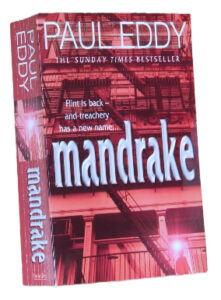 When we meet her in Mandrake, (Paul Eddy‘s second novel with her as its central figure), she is deputy director of the Financial Strike Force, watching in horror as one of her special agents walks into a trap during an elaborate sting. An operation designed by Flint to trap Karl Gröber, a former East German spy turned ruthless financial manipulator in a big money-laundering scheme through US banks. Code name Operation Pentecost.
The federal agent, Ruth Apple, is killed right in front of Grace, a gun in her mouth, before being hurled out of a helicopter. The criminals have vanished, and Flint’s own conduct is now under question, because the supposed water-tight new identity the agent had adopted had been cracked open like cheap glass by Gröber and his men.
There is only one explanation for this: someone has leaked vital information. Someone close to Grace. Close enough to anticipate her every move. Uniquely placed to betray her. MI6 have given this traitor the codename Mandrake. Who exactly is he? There is only one person who fits the profile: Grace’s own husband, Ben Gates. One by one all the ‘facts’ Grace knew about her gentle bird-obsessed husband disintegrate. She has no idea who he really is or where he is.
For Ben Gates never did actually exist except in the mind of his wife.
His entire backstory was an elaborate fiction.
 But someone in Gröber’s team certainly knows who she is and where she is. Just when she thinks they are on the tail of the middle men, their plans are thwarted. And she acquires information about Gröber which chills her to the bone. He has from an early age been a cold and unscrupulous fanatic prepared to betray and use even his own family. She will not rest until she hunts him down, and he leads her to her former husband. Not even when she hears of both their reported deaths in an explosion followed by the downing of two helicopters.
Such is the nature of spying and the work of agents in any country, that they are rarely what they seem or what they purport to be. And Eddy has created a cast of master-manipulators calculated to engender confusion and distrust. I found myself suspicious of everyone and struggling to sort out their real affiliations. But there was no neat tidying up of ends to slot everyone into place; instead he has cleverly left several plot endings hanging to pave the way for future volumes featuring Grace Flint.