Painting the Darkness
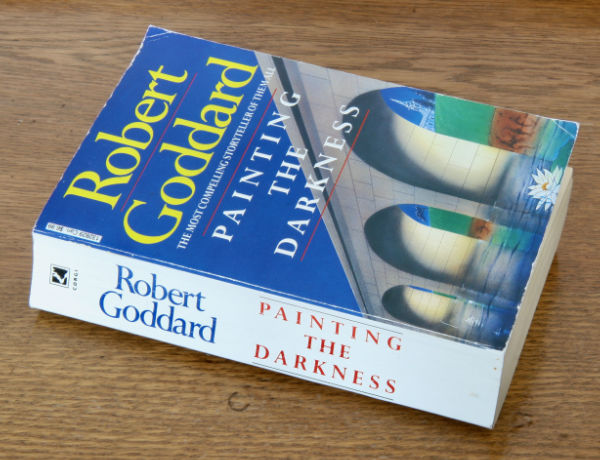 Robert Goddard is a master of language and of intricate historical skulduggery. In Painting the Darkness he’s drawing on the tried and tested theme of a stranger turning up claiming to be the long-vanished heir to a baronetcy and an estate in the nineteenth century, but boy, there’s nothing hackneyed about his take on this storyline! It’s 577 pages of unflagging engrossing suspense.
The year is 1882. William Trenchard is sitting smoking his pipe in the autumnal garden of his family home, on a Sunday afternoon, when the garden gate creaks open to admit a tall slim stranger. He has no idea of the impact this man will have on his life, but an hour is all it takes to turn the previous ten years of his life upside down, and set in train a path to ruin and destruction.
The man, James Norton, has come to reveal his identity as Sir James Davenall, former fiancé of Trenchard’s own wife Constance, who was thought to have inexplicably taken his own life eleven years ago, mere days before the scheduled wedding, when he was only twenty-three years of age. He also claims to be the rightful heir to the family estates which went to his younger brother Hugo. So determined is he to prove his case that he visits his alleged mother, brother and lawyer cousin, his doctor and old nanny, as well as his former fiancée, seeking confirmation.
In spite of his family resemblance, and his intricate knowledge of their family history and James’ life from boyhood to alleged suicide, all except the nanny initially refute the suggestion this stranger is their long dead relative, and yet … a nagging doubt remains in Constance’s mind. This in turn puts uncertainty into Trenchard’s head: maybe he doesn’t know his wife as well as he thought he did. Now both are harbouring secret thoughts and information unknown to the other. And little by little a rift widens between them; both erode the boundaries of trust.
The alleged James Davenall reveals more of his hand. All the money, all the status and prestige attached to the baronetcy, his own reputation, are as nothing compared with the love of his life. He will stop at nothing, accept no offers or compromises, in his efforts to win her back. But … he would give up every claim if Constance herself asked him to. Selfless devotion? … or a clever and disarming strategy?
As Norton repeatedly out-manoevres him, William Trenchard is driven from simply trying to protect his marriage to a full blown obsession to prove the interloper is an imposter; an obsession that leads to his own incarceration. The family lawyer, also a Davenall, takes up the case … they pursue it through the courts … the repercussions spread through the extended family. Terrible secrets are unearthed; conflicting claims and interests lead to fearful consequences. And the real truth is more shocking than anyone could ever imagine.
It takes a high level of skill to juggle time and place and an ever-evolving plot and a large cast of characters to this level of brilliance, but Goddard never puts a foot wrong, never eases up on the tension. Even when we eventually learn the truth about James Norton/Sir James Davenall we are unprepared for such a devastating unravelling revelation.
And as ever his writing is impeccable. I’ll share just two excerpts by way of illustration, both descriptions of minor characters in the story.
Sir Hardinge Stanley Giffard, Queen’s Counsel, Member of Parliament for Launceston and Solicitor-General in the previous Conservative administration, had about him, both actually and metaphorically, many of the attributes of the bull-terrier. Short and stoutly built, with a pugnacious air that age and a succession of legal triumphs had matured into a menacing certainty of manner, he was, in court, wig and gown and meticulous mastery of a complex brief, an awesome spectacle.
Mr Justice Wimberley had entered the bench from his door behind the throne before the usher had completed his announcement and now squinted querulously around at the rows of awkwardly rising figures. He was a small, orderly, fussy little man with a bobbing, egg-shaped, sharp-nosed head that gave him, in full judicial regalia, something of the appearance of a startled and ill-tempered moorhen. He peered distrustfully at the crowded court, as if to suggest that he had expected – and hoped for – a scantier audience, then took his seat with a resentful tug at his robe.
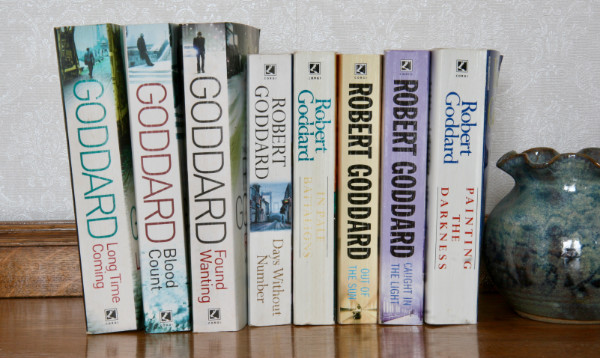
One of Goddard’s very best and most compelling novels in my opinion.
The story behind the crime
Published author, Wally Lamb, has always loved teaching. So when the York Correctional Institution in Connecticut in the USA appealed for volunteers to help combat the despair and defeat that had overtaken the female prison population in the wake of a series of successful and attempted suicides at the turn of the century, he responded with an offer of writing workshops.

But teaching writing in such a setting proved to be a considerable challenge; it took time and patience to penetrate the barriers the inmates raised. However, once the women let down their guard and found their voices, he was amazed at the courage and insights they exhibited. It became very evident that they had been imprisoned by abuse, rejection and their own self-destructive impulses long before they had entered the criminal justice system. They carried scars spanning their whole lives. The process he started not only unlocked their creativity but began a transformative journey of healing, and a pathway from despair to hope and triumph.

In Couldn’t Keep it to Myself, their stories have been collected together, and present a moving and powerful testament to the potential for writing – regardless of its literary merit – to enable vulnerable people to gain self-awareness and the motivation to change their lives for the better. As their mentor and facilitator Lamb kept his own editing of their work to a minimum in order to allow these authentic voices to tell it as it was for them, tweaking just enough to ensure clarity and pace and drama.
The end result makes shocking reading. These are experiences most of us only read of in fiction. Childhood rape. Poverty and abuse. Dysfunction on a grand scale. Rejection and discrimination. Cruelty and thuggery. Depression and full blown psychotic illness and addiction. Degradation and dehumanisation. Suicidal ideation and PTSD. Without exception, all the authors describe histories fraught with such horrors.
But, by encouragement and sensitive guidance, by publishing their collective stories, Lamb has unearthed the humanity in the lost and the lonely, the victims of drink and drugs and self-destructive habits and mental illness and society’s prejudices … and given them a voice.

… little by little, I came to understand who I was beneath all those bad habits and bad decisions.
… no one deserves to be talked down to and assumed valueless – no matter what their poisons.
I began writing about my life because it was the only way I knew how to keep my sanity in this place of confusion. My writing is a sanctuary in the middle of each day.
Writing gives me a sense of peace.
Writing’s helped me figure out who I am and who I want to be. My body’s still in prison but my spirit’s finally free.
Linguistic flair
 I’ve long been a fan of Robert Goddard‘s writing. His first novel, Past Caring, published in 1986 remains one of my all-time favourites.
He’s widely acclaimed as a ‘master of the clever twist ‘, ‘second to none when it comes to duplicity and intrigue’, a ‘master of manipulation’. He chooses difficult historical contexts and multiple geographical locations and languages, but manages to keep the suspense and tension going till the very end, somehow convincingly weaving authenticity together with fiction. But what’s seldom mentioned is his skill with language.
Found Wanting, which came out in 2008, is a complex roller coaster of a tale centring on the possible survival of Grand Duchess Anastasia Nikolaevna, the youngest daughter of Tsar Nicholas II, the last emperor of Russia. The family were executed in 1918 by Bolshevik revolutionaries, as we all know, but rumours continued to circulate that Anastasia escaped. Goddard has spun another yarn about a woman who claimed to be the royal escapee.
 Far too many thrillers are sloppy with respect to grammar and language, so for me the joy of this book lay in the lovely turns of phrase scattered throughout Found Wanting. A few examples will best illustrate what I mean.
[The pelican crossing] bleeps and blinks in service to the dark-suited men and women crossing in both directions who are bound for their desks and work places in the ministries either side of Whitehall. Many already have their security passes dangling round their necks, their identities surrendered and declared, their working weeks about to begin in variations on an institutionalized theme.
In short, he possessed charm in abundance. But even abundance can be exhausted.
His top-floor room, set in the mansarded roof, gave him a wide-ranging view of numerous other roofs, but nothing else. The panorama of louring sky, domes, gables, slates, gutters, chimneys and fire-escapes was a metaphor for his plight. He could see a lot, but none of what really mattered.
Birgitte gave him a faintly sympathetic smile that hinted at a vivacious persona she left at home every morning.
‘Straub,’ said Lund, in a tone that suggested it was Danish for drain blockage.
A delight to read and savour.
Finding understanding; gaining perspective
Hey ho! I’ve come to the halfway point in my serious study this year, a point where I have to conclude that prayer is a very personal issue. I’ve listened to others talking about it; I’ve read a stack of books on it; and I’ve tried to explore the essential underpinnings (the What? Why? How? level questions) myself in talks. Big sigh. It’s way harder to share than any other topic I’ve tackled so far. Seems, my thoughts are unlikely to run parallel with yours; my understanding is probably not going to reflect yours. What’s still more sobering is that it appears one can study the whole subject too much and end up losing perspective on it. Yoiks!

I’ve had a few earnest recommendations along the way, and have done my best to follow them up. A recent one was for Harry Emerson Fosdick‘s 1915 book on the subject, The Meaning of Prayer. It’s a slim volume, brown pages, and couched in very dated language. OK. I’ll give it a go …
Suffice to say I’m afraid I didn’t share the enthusiasm of the person who pointed me in its direction. However, that was itself reinforcement of my conclusion thus far: each of us has our own ideas and experiences and preferences on the topic; discussing it openly has it’s limitations. I confess it’s been a bit deflating to discover this, however, I shall persist with the study for my own education and enlightenment, though clearly I need to pace myself with this potentially dispiriting task.
 With that resolve in mind, I felt I’d earned some light relief, so I turned to The Stolen Baby by Diney Costeloe – a new author to me.
I chose it for two reasons: it deals with the attachment of a child to it’s mother/carer; and it’s set in wartime Plymouth. I was four when my own parents moved to a place in the country in Cornwall, ten miles from Plymouth, so I remember the devastation caused by the relentless bombing of the city and the emergence of a new one. I grew up knowing first-hand about Tilley lamps and primus stoves and romper suits and babies left outside shops and the rigid rules of etiquette (Thou shalt not allow a male to enter the sacred portals of a nurses’ home) … all of which characterise the world of this tale. I myself worked in the two main general hospitals there during the 60s (misnamed in The Stolen Baby!).
The book is undemanding, and certainly brings alive the horrors of the frequent devastating air-raids, and the tragic consequences of war for so many families. It would have been perfectly possible for a baby to be found in a bombed house alone and crying, for his family to be missing presumed dead, for someone else to find him and take him home to be cared for. In the chaos and fog of war, anything could indeed happen.
… the war has changed everything. It’s turned everything topsy-turvy and you find out what’s really important in life.
And delving into that past era has helped to restore equilibrium in my perplexed and overloaded brain now so many decades later!
Book heaven
 A short trip to Northumberland last week gave me a golden opportunity to visit one of the largest secondhand bookshops in the country: Barter Books at Alnwick – once famously described at a ‘national institution’.

Housed in the listed former Victorian station building. it’s home to over 350,000 used books, all methodically catalogued and displayed. Famous quotes garland the stacks; tantalising glimpses of still more treasures invite you ever deeper.

And more than that, the huge space includes wonderfully conducive oases of calm and comfort for the book-hungry visitor, with plush seating, a real fire, the old water fountain fostering an olde worlde ambience.


It even boasts a model railway running overhead in one area, preserving the sense of trains coming and going.

It’s the kind of place where you sink into a much-used baggy chair and sigh with relief that books – real hardcopy books, are very much alive and well. And by all means read before you buy, madam. Coffee, sir? Jersey milk ice-cream, anyone? Mmmmmmmm … I may be gone some time.

The Greatest Story
I guess most of us know Edward Michael Grylls, aka “Bear” Grylls, as an intrepid adventurer, TV presenter, and the youngest ever Chief Scout.
But did you also know that last year he released a book called The Greatest Story Ever Told: An Eyewitness Account? 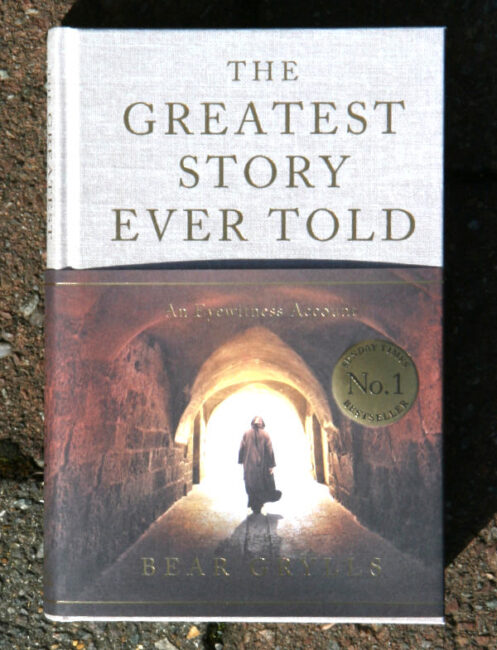 Nor did I until our local church gave copies out at their Christmas Midnight Service – beautifully bound copies what’s more. And because this didn’t seem to fit with the profile of this man of extreme action, Bear Grylls, I was the more intrigued. (That probably says more about my preconceptions than about him.) But he says himself, this is the hardest thing he’s ever done, and the best. He has spent a lifetime unravelling the truth about Christianity and is still on that journey, but his faith is the backbone and source of strength in all his escapades and in his everyday reality.
It’s a tale of an impoverished Middle Eastern child of the first century becoming a renegade teacher in the Roman Empire. The familiar stories of Jesus of Nazareth’s birth, life and death are told imaginatively through the eyes of five prominent eye-witnesses: his mother Mary, disciples Thomas, Simon and John, and Mary of Magdala.
I say familiar stories, but there are also intriguing alternative viewpoints offered. For example, I’d never thought of Mary being wracked with guilt because she’d taken her own baby boy out of the reach of Herod’s merciless slaughter of boys under two years of age, leaving all her friends and contemporaries’ precious children to be murdered instead. Or her maternal anxiety when her beloved grown-up son vanishes into the wilderness for forty days after his baptism. She knows it’s a bleak inhospitable place; has he succumbed to starvation and the elements?
And the details bring certain events and emotions into sharp relief – the real grief Jesus felt at the execution of his closest cousin and friend John the Baptist; the sheer brutality of Roman punishment prior to crucifixion (very hard to read); the terrible burden of guilt the disciples probably carried for not showing the love Jesus had taught them when he needed them most, for denying him, for betraying him. Sobering stuff that challenges the present-day reader to think again – the cynic and the angry, the impulsive and the lost, alike. Their stories, all our stories, are wrapped up in Jesus’ story, as Gryll’s puts it.
The Pindar Diamond
 The storyline in The Pindar Diamond by Katie Hickman is somewhat complicated, unravelling gradually so that we readers only make full sense of it towards the end.
But for me its main strength is in its evocation of a time and place.
In this case it’s Venice in the 1600s. The plague is arriving. I could see the famous Venetian silhouette, the peeling plaster, the tiny bridges, the gondolas gliding silently along at night, pinpricks of light in the oily black water. I could hear the sound of the mellow church bell carrying clearly across the streets and canals.
It’s the height of summer, fiercely hot and the stench of the murky canals pervades the city. But merchantmen and their sleuths still ply their trade in luxurious fabrics, exotic spices and fabulous jewels in this centre of commerce.

Closer up I could picture the rich silks and brocades, the velvet doublets and pantaloons, the massive canopied beds, the painted courtesans in blood red damask robes, the legendary Venetian masks. 
But this is the seventeenth century. Life is cheap; hygiene is dubious; fortunes are lost and won at cards; freak shows parade those who are unfortunate enough to be born disabled or ugly or exceptional. Even in a convent, escaping daughters of noblemen with no vocation wear silk and embroidered slippers beneath their stiff black habits, wear their hair long beneath the regulation wimples, gorge themselves on luxury dishes.
The story flips from brothel to convent, gaming den to Sultan’s harem. It draws in a mermaid baby, tumbling acrobats, merchants and pirates and eunuchs, a giantess who gives her life to spare another woman’s baby degradation. All contribute to this vivid picture of a bygone era in a timeless city in Italy.
 At the centre of the intrigue is the priceless Ottoman Sultan’s Blue diamond, a stone from India of rare and exceptional size and beauty, true blue-white, the ‘colour of moonlight’. Engraved in one facet is a Moghul inscription: My heart’s desire. It’s been carried in a velvet pouch; gnawed and wrenched from the dead hand of the Sultan’s mother; stolen by a nun; gambled with and lost at cards; but in the end even this fabulous gem is not to be compared to the value of enduring love.
An historical romance-cum-mystery full of scheming and exotic characters that will transport you to a different world, thanks to the linguistic skill of a writer.
A Silent Death
As I’ve revealed before, I’m a fan of Peter May’s novels. A Silent Death made me appreciate all over again the skill of a writer who manages to create such memorable three dimensional characters.

John Mackenzie (38)
Ex-Metropolitan policeman, now an investigator with the National Crime Agency.
A brilliant mind, degrees in quantum physics and mathematics, a talent for languages, and a forensic ability to read a crime scene. But so socially inept, obsessive, and pedantic that he manages to alienate almost everyone he meets – his wife, children, bosses, colleagues, neighbours.
Says what he thinks without filtering; precious little tact or discretion; unable to see why the blunt truth is not always diplomatic.
Mother was an alcoholic, father (also a policeman) died by his own hand, leaving John to be brought up by a paternal uncle and aunt in Glasgow.
Estranged from wife, Susan, and repeatedly at odds with his two children.
Jack Cleland aka Ian Templeton aka Mad Jock (36)
Also Scottish, expensively educated; a graduate of Fettes College in Edinburgh, and Oxford University.
Wealthy parents had no time for him and he was starved of affection.
Thick blond-streaked brown hair.
Fastidious in his personal hygiene and expensive dress.
Gym fit.
Early in his career, made a fortune as an investment trader, but still hankered for untold wealth and power, so turned to drug trafficking.
Hotshot with a gun, he’s already killed at pointbank range a corrupt police officer heading up a drug cartel, and an undercover cop who betrayed him.
Now top of the most wanted list, a fugitive somewhere in Spain.
Cristina Sánchez Pradell
A petite junior police officer in Spain.
Married to car salesman, Antonio, with a 10 year old son, Lucas.
Only sister, Nurita, is very ill, currently undergoing chemotherapy for cancer.
Their blind and deaf Aunt Ana is a very wise woman who has had a raw deal in life. She was very active in bringing up her two nieces, and they are devoted to her. She has a guide dog and communicates through a computer that translates conversation into braille.
Has qualities that bring out the best in people.
Plot in a nutshell
It’s a warm May night on the Costa del Sol in 2020 when Cristina answers a call about an intruder at an expensive villa in Spain. What she doesn’t know is that the villa belongs to the fugitive Cleland under the guise of Ian Templeton. He was taking a short spring holiday in Barcelona with his girlfriend, Angela, but neglected to pack certain folders, so has returned to the villa to retrieve them. A neighbour spots his silhouette and rings the police.
While her colleague is checking outside, Cristina enters the villa, gun raised. In the darkness Cleland mistakenly shoots his girlfriend, Angela, three times, fatally wounding her, ending both her life and that of the child she’s carrying. He instantly screams revenge on Cristina, vowing to kill both her and every member of her family.
He’s taken into custody (a major coup for Cristina and the Spanish police) but arrangements are made to deport him to the UK for trial. And escorting him becomes the first task the National Crime Agency asks new recruit Mackenzie to perform. However, once Mackenzie is airborne on his way to Spain, Cleland escapes custody; three guards escorting him to the airport are shot dead in the process. The fourth guard is Cristina’s brother-in-law, Paco, shot in the leg but allowed to live to reinforce the threat to Cristina and her family.
With Cleland once more at large, with nothing to lose, and with deadly intent, the race is on. Mackenzie is retained because of his fluency with both English and Spanish. And he and Cleland play a dangerous game of cat and mouse with the lives of eight innocent people at stake.
Peter May does what he always does, maintaining high tension and fast pace, evoking places superbly, keeping the reader on the edge of their seat. But for me, the two chapters devoted to Aunt Ana and how she lost her sight, her hearing, and the love of her life, rather jarred, breaking the momentum of the story. However, they did serve to engage extra empathy for Ana who plays a pivotal role in the narrative line. I’d rather the facts about her had emerged either through exchanges with her nieces or during her incarceration with Cleland.
A USP for me though, was Mackenzie, who surely has the best lines. A pedant without a filter who speaks as he thinks and is uncompromising in his principles. Fabulous in fiction; a nightmare in reality!
Skullduggery in deep places
Well, if you attempted to access my website/blog in the past 12 days, you will have been unsuccessful. Instead you will have been met with a stark message saying in large bold letters: Forbidden …! Yoiks!!
The reason? Persons unknown managed to infiltrate my site with several thousand fake posts – about casinos of all things!! None of these were visible at my level of entry to the inner workings, but when someone in the casino world complained about the content of some of them, the host promptly pulled my site! My website designer (Keren at Creative Infusion) diagnosed the problem as deep-seated but outside her remit; however, she was very willing to liaise between all parties as necessary, so a big shout out to her. I happen to have a wonderful computer-science-graduate grandson, Alexander, who does have the skill-set for this task, and he calmly and expertly searched for and found the offending files, removed them forthwith, and lo and behold, we’re back in business looking and sounding as before! Stars and medals all round, Alex!
I am in awe or anyone who has these impressive abilities and knowledge, and can’t thank them enough. Let’s respect and honour all who work away in the background, unseen, and too often unheralded, to keep our communication systems functioning apparently effortlessly. I salute you all!!
Research continues
In amongst all the other things punctuating life, the serious study on prayer continues quietly and unseen. It’s actually quite useful that I have mundane responsibilities keeping me out of the study for lengthy periods – gives the material I’m ingesting time to simmer and diffuse and settle.

That process has actually been helped by a friend who’s going through a very diffuclt time in his life questioning me about pain and suffering. Having to marshall my thoughts in order to give a semi-coherent response to his deep questions helps me sort out the theory from what I can accept or even believe. My own personal experience doesn’t bear out some of the most pious ideas, and I’m seriously allergic to platitudes.
Though I still have a lot of my own issues for which I can offer no satisfactory answer, I am gradually drawing up a workable framework within which to hang them. It’s a start. And I doubt very much if I will ever reach a comprehensive conclusion that covers everything. Some things may just have to be relegated to the category of ‘Mystery’ – which, when you’re considering the interface between heaven and earth, is just as it should be.
Next week I’m introducing the subject to a couple of quite different audiences and inviting their thoughts and reactions so that should help to refine my thinking too.