The Bullet that Missed
As you know, I don’t like to judge an author on one book – especially perhaps one that has catapulted into the bestselling lists. So, I bought two of Richard Osman‘s novels and have just finished reading the second one.
 The Bullet that Missed (clever title, by the way) features The Thursday Murder Club (TTMC) again. Once a week this gang of four pensioners in a retirement village, meet to look over old police files and try to solve murders, although their remit is decidedly elastic. This time they’re together investigating the unsolved Bethany Waites case: a brilliant young reporter who vanished while investigating a massive VAT fraud relating to the import and export of mobile phones. What is already known?
She was murdered almost ten years ago
She had got too close to the secrets of the fraudsters.
Her car plunged off of Shakespeare’s Cliff near Dover, late at night.
Someone had been in the car with her just beforehand.
There were ambiguous messages on her phone.
She left a note for a fellow reporter: I don’t say this often enough, but thank you.
Well … the police may deem it murder, but Elizabeth Best of THMC knows you should never trust a murder without a corpse. And she should know: she has faked a few deaths of her own over the years as an MI5 agent. And Bethany’s body has never been found.
Fast forward ten years and Elizabeth is suddenly being bombarded with threatening texts in her present real life. She’s wary, but then, uncharacteristically, makes a big mistake: she goes for a walk with her husband at the same time along the same route every day, giving her enemy an open invitation to strike her down and abduct her. And that someone wants her to go on a deadly mission: to kill a man she knew years ago, or her best friend Joyce Meadowcroft’s life will be forfeit. Elizabeth’s husband Stephen, abducted with her, is suffering from dementia, and at the stage of being aware something isn’t right but not sure what it is. He has flashes of perceptiveness however, and now, rare and expensive books in the library where his abductor took them, jog his memory and help him to identify Elizabeth’s tormentor. She links up with an old ally, a former KGB colonel, Viktor, the very man she was instructed to kill, and they combine skills to attempt to outwit their common foe, a money-laundering Swede nicknamed The Viking. He is closing in but hasn’t bargained on their disarming friendliness or cunning.
Joyce Meadowcroft meanwhile, unaware that her life is in Elizabeth’s hands, is beavering away at the cold case and involves her lawyer daughter to dig deeper into the facts relating to the murder of Bethany Waites. A gathering collection of anomalies move thinking on. Then one of the the key players in the case is murdered in prison. A fellow inmate, a notorious drug baron, manipulates the elderly sleuths and plots to kill one of them (Ron) and his associate once she is released. The past and present become inextricably tangled.
The introduction of new characters such as the KGB colonel is definitely a brilliant move in the machinations of TTMC. Convoluted layers of intrigue unravel, revealing different facets of the truth or lies according to the differing perspectives. Master-crooks get involved, enemies become allies, confessions become red herrings, bodies keep turning up, big money creates temptations, cryptocurrency offers new opportunities, careers are made and broken in an instant. Osman is setting things up to weave ever more complex stories. And therein lies the test for a writer – keeping all the threads perfectly woven and unbroken, maintaining the tension without unduly repeating the detail or pattern. Methinks this mighty mind will be well up to the challenge.
Overall assessment after two books? Much more depth and complexity than I first thought. Rather like the deceptively simple four main elderly characters in TTMC. Still not books I would just have to hang on to, and I’m not racing to get the others in the series, but I’m looking for a good outlet for these two – someone looking for light-hearted easy-read diversion from life’s stresses.
Richard Osman’s meteoric rise
OK. I give in. I’ve resisted buying his books for long enough. But Richard Osman is hitting all sorts of award lists and records these days so I might as well see what all the fuss is about. It was this kind of resigned approach I took to JK Rowling back in the pre-Harry-Potter-worldwide-crazy days … and look what happened there!
From what I’ve read and seen about Osman’s debut series, it has shades of Alexander McCall Smith‘s gentle humour. Poking fun at life’s idiosyncrasies without malice, but revealing a keen understanding of the human psyche and behaviour. It follows a group of elderly amateur sleuths in a sleepy retirement village in rural Kent who form a club to investigate unsolved murders.
 In his first novel, The Thursday Murder Club, a rich but unscrupulous local builder cum property developer, Tony Curran, is actually bludgeoned to death in his own vast kitchen in real time on their doorstep. A photograph of three men is left on the work surface nearby. The intrepid TTMC gang use every wile known to them, and a few new ones too, to infiltrate the police squad dealing with this crime. And then someone else is killed with an injection of fentanyl in full view of many people – including TTMC – during a sit-down protest against the digging up of graves in which nuns are buried in The Garden of Eternal Rest. This time the victim is someone no one likes – Ian Ventham – a unscrupulous avaricious man bent on owning the land on which the graves are situated.
Much as he rather begrudgingly likes them, the elderly sleuths stretch the patience of Inspector Chris Hudson when they keep quiet about the discovery of a skeleton buried illegally in the nuns’ cemetery; and again when they send bones away for forensic analysis. They take risks, interview people they suspect, gain information by nefarious means. All under the guise of naive innocence and old age.
Though the intrepid quartet have an air of elderly eccentricity, even scattiness, in reality they represent a combined force to be reckoned with and seem to find an answer to everything. Somehow they manage to get information often before the professionals are asking the questions. But they are essentially engaging and friendly and beautifully hospitable and friendly. One can’t help but root for them.
One example from the brightest spark in the gang, Elizabeth, a former MI5 agent, gives a flavour:
‘You don’t know who dug up the body and you won’t hear the answer from any of us,’ continues Elizabeth. ‘You don’t know who took the bones away for analysis and you won’t hear that from us either. At the end of the evening you might try and explain to the CPS that four people in their seventies and eighties have failed to report digging up a body. For what reason? With what evidence, other than the inadmissible confession you’ve taken from us this evening? And with four suspects, all of whom are quite happy to go to court, smile happily and pretend to mistake the judge for their granddaughter and ask why she doesn’t visit often enough. The whole process is difficult, costly and time-consuming, and achieves nothing. No one is going to prison, no one is getting a fine, no one’s even going to be picking litter by the roadside.’
The prose is witty, charming, quirky. Pure escapism and just what I needed. And the plot unravels satisfactorily through many a twist and perfectly civilised shenanigan.
Richard Osman’s background as a comedian as well as TV presenter, is not far from the surface, and I could well imagine him chortling as he conjured up these crazy scenes and endearing characters. What I didn’t know is that he has such poor eyesight that he has to learn his scripts off by heart because it’s too difficult to read the autocue. But his stellar career belies his diagnosis and I so admire his determination and spirit launching into yet another successful career change.
No Second Chance
…when I get seriously lost or afraid in the realm of raising a child, I look at the helpless bundle in the crib and she looks up at me and I wonder what I would not do to protect her. I would lay down my life in a second. And truth be told, if push came to shove, I would lay down yours too.
.. I can only be as happy as my saddest child.
 The very day I started reading this book – another Harlan Coben thriller, No Second Chance – a new little life came into our family. Infinitely precious. Unutterably fragile. Totally innocent.
 Dr Marc Seidman is a specialist in paediatric reconstructive surgery – he takes care of children, mostly from overseas, who suffer from deformities through birth, poverty or conflict. Then one day he wakes up in ICU himself, and discovers he has been shot twice, lost consciousness, and his heart had stopped. He learns he has been hovering between life and death, battling sepsis, for twelve days. His rich but volatile wife Monica is dead – also shot. His beautiful baby daughter Tara is missing. For twelve days already.
The police find fingerprints in the house belonging to Stacy, his drug-addicted sister, whom he hasn’t seen for six months. And then she too is found dead.
The day Marc is released from hospital his father-in-law reveals he has been sent a snippet from Tara’s babygro, pink with black penguins. And little wisps of baby hair. The ransom note demands two million dollars. Marc himself is to deliver it. But he doesn’t follow directions to the letter and the robotic voice on the phone is implacable: No second chance. Marc will live with the consequences for the rest of his life.
But with no grave, no body, a glimmer of hope flickers on, hiding, taunting, never quite leaving Marc. By now he must also contend with some of the police believing he was the mastermind behind the kidnapping.
Then an old flame – Rachel – turns up, a former agent with the FBI. Why had she suddenly retired? Are the rumours true that she shot her husband dead?
A second ransom note is sent eighteen months after the first, again with hair genetically matched to the first sample. But are they from Tara? Is this a trap? A glimpse of a child silhouetted beside the man in the flannel shirt spurs him on; a second look at the face of the child in the man’s car convinces him it is not his daughter.
But if there is the remotest chance she could still be alive, Marc cannot give up. He co-opts Rachel and her skill as a special agent and together they unravel circles of heartbreak and need, deceit and greed, leading them closer and closer to answers to the big questions that have been haunting Marc. Who shot him? Why didn’t he hear the glass breaking? Why was Monica naked? What is the connection between his wife and the girl who lived in his house before he bought it? Is Tara still alive? One by one the pieces of the jigsaw slot into place but … there’s still one vital piece missing.
In his acknowledgements Coben lists seven technical experts who helped him in the creation of this book, adding, ‘Any mistakes are theirs and theirs alone. After all, they’re the experts, right? Why should I take take the heat?’ Goes with his whole confident style, I’d say! Wish I had his courage and assurance.
Faith and doubt
 I was brought up in a small religious community with a distinctive set of beliefs that defined and set it apart. But when I started to study Scholarship-level zoology in my teens I was forced to really question what I’d been taught since it was at odds with what science revealed. I had to make choices. I’ve been probing and challenging my belief system ever since, most of the time with my head well below the parapet.
So author/speaker/activist/theologian Brian McLaren‘s experience of striving to make sense of everything resonated powerfully for me. He had a similar background. He has struggled with the profound questions that lead to doubt and loss and perplexity.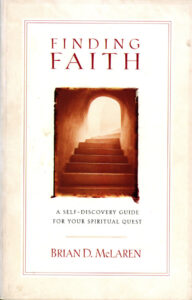 In his books: Finding Faith and Faith after Doubt, he shares his journey to the conclusion that his hunger for growth and understanding has led him to a better place. Doubt is far from a negative thing, an enemy of faith; rather it’s a portal to a more mature faith, something genuine and humble and more giving. Phew! Wish I’d known that at 17!! All that guilt. Secrecy. Fear.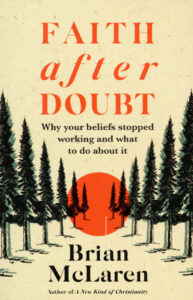
The books are well-written, engaging, full of personal touches and stories that bring the topic and the dilemmas alive. McLaren’s analysis is helpful too – the difference between beliefs and faith; the driving forces behind behaviours in the church; the transformation from a sense of superiority to one of vulnerability and revolutionary love; and the realisation that the mystery of life is so far beyond the human brain to conceive of as to bring the questioner to a place of wonder and reverence for a truth beyond comprehension. It’s OK not to have all the answers. It’s OK!
Serious stuff this week but it lifted my spirits with its honesty and glimpse of freedom. I still have lots to discover but at least I’m now at ease with my questioning.
Fool Me Once
I don’t subscribe to Netflix but you’d need to be an ostrich to have avoided the publicity given to one of its new dramas. On the buses, on social media platforms, on massive posters.
 I haven’t seen the film, but I have read the book, Fool Me Once, by one of my favourite authors, Harlan Coben. Indeed, I have no less than eighteen of his novels on my shelves! Brilliant plotting, terrific tension, gripping storyliners, lots of confusion. Keeps you guessing till the end.
Fool Me Once revolves around Captain Maya Stern, a female helicopter pilot, now retired from the army, but plagued by incapacitating flashbacks to a mission where she killed some civilians whilst rescuing comrades in a war zone. In her private life she’s Mrs Joe Stern, married into a wealthy and powerful family, mourning the loss of her sister Claire and husband Joe, both murdered, both shot dead.
Maya has to find out how and why her beloved sister died, leaving behind a grieving husband, Eddie, and two children. She was following up a clue relating to Maya’s army experience, getting too close to secrets, when she was tortured and shot. Maya, following in her footsteps, finds herself negotiating with some dubious characters who all have something to hide, and her investigation leads her to the untimely deaths of a group of rich boys in a posh private school, one of them Joe’s own brother, Andrew, and his best friend, Theo. Andrew died in mysterious circumstances, falling off a boat far out at sea, fifteen years before she met and married Joe. Cover-ups, dirty dealings, money buying silence – it’s all there. But how much of this is the product or her own seriously troubled mind?
Then just when I’m starting to see the full picture, Coben does the unexpected and pulls the rug from under my feet. A master storyteller. One day I might watch the film but I really struggle with dramatisations that aren’t true to the original, and this one has attracted a lot of mixed reviews; I don’t want to have my mental images spoiled. Neither Martin Scorsese nor Steven Spielberg have been on the phone lately, but I’d be nervous of anyone massacring my creations! However Harlan Coben is an old hand at negotiating adaptation with film folk, so I guess he knows just how to achieve a healthy compromise. At any rate he has two more in the pipeline with Netflix, so watch this space.
While She Sleeps
This is something of a moral quandary for me. Do I review a book that I find rather flawed when I could just stick it into a charity shop and say nothing? I’ve done that before. In the end I decided to go for it because it so much reminded me of my own first novel and the issues I had when it was published way back in 1994 – in my case, inadequate editorial scrutiny from people who knew what they were doing, poor proof-reading, too much trust placed in the publisher to get things right. And a terrible sense of disappointment and self-reproach because I had been naive enough to trust in what was promised. So I’m going to put scruples to one side in order to make a point. After all, this is a blog about writing, and we can all learn from other people’s mistakes, mine included.
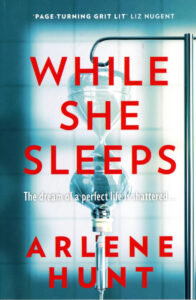 The book is While She Sleeps by Arlene Hunt. The cover is my kind of thing: tick.
The blurb tells me a young woman who is talented and loved, is lying in an induced coma following a murder attempt: tick.
Her family-life is far from perfect and several members of it are in the frame. Another tick.
So far so good. I bought it. And started reading straight away.
Instantly I’m in my comfort zone – fertility, family dynamics, pathological relationships, mental illness, moral responsibility … Yep. Lots more ticks.
But then … oh dear, various things started to really irritate – typos galore; characters misnamed; glancing references to other investigations by the police without a framework on which to pin them. I had to write a profile of the principal characters in order to stay with their details and links to other bit-players. Looked rather like a profile board for a murder in a detective’s office! And then the denouement – well, one minute we had so many loose threads it was anyone’s guess, and then wham! all is revealed from camera footage.
What were Hachette Books Ireland thinking of? Do they have editors and proofreaders these days? I only hope the author didn’t suffer the same sense of disappointment I felt all those years ago. If these were mistakes quite outside her control, she has my sincere sympathy.
The power of drama
Oh wow! What an amazing response to a drama.
Mr Bates vs the Post Office is based on a real life story of one of the biggest miscarriages of justice in British legal history. More than 700 sub-postmasters and -mistresses were falsely accused of theft, fraud and false accounting, after faulty software made it look as if money was missing – large sums of money. They had long complained about bugs in the system after it erroneously reported shortfalls; some had even used their own money to plug the gaps. Following the convictions, lives were devastated. Reputations were shredded, families bankrupted and shunned. Marriages, businesses and job prospects were ruined. Some people were imprisoned. Some took their own lives.
Prosecutions for these supposed thefts took place between 1999 and 2015. After 20 years of maintaining their innocence, campaigners eventually won a legal battle to have their cases reconsidered. Twenty years!
A public inquiry began in February 2021, but three years on many victims are still fighting for justice, or to secure full compensation. To date only 93 convictions have been overturned, even though it is now undisputed that the software was to blame. That same software, Horizon, is still being used by the Post Office; this new version is described as ‘robust’.
The delays are unconscionable, but a drama has precipitated real action. From 1-4 January 2024 ITV aired four instalments of Mr Bates vs the Post Office, with Toby Jones playing the title character, sub-postmaster Mr Bates, with his customary skill and appeal.
Then on Wednesday 10 January, the BBC devoted an hour of the morning news programme Breakfast, to listening to nine of the real life victims of the Post Office scandal, and allowing them to ask questions of the relevant government minister on air.
At lunch time that same day, 10 January, (yesterday) the prime minister announced new legislation to ‘swiftly exonerate and compensate’ victims.
Wow! I rather suspect the British public will not now allow this promise to go unfulfilled. Such is the power of storytelling.
Pathological relationships
I was standing on the shingle bank when they towed her boat back in. The last of the sun was slipping below the horizon, pulling the dying day after it, turning the water of the Solent black … The lifeboat was coming up from the Needles, its orange decks a bright mark in the gloaming, but the throttled down rumble of its engine reached over the surface of the sea like a growl … Less than a minute later, the engine was cut and silence fell.
It was as if the town had taken an inward breath. Nothing moved.
…
They had found her boat, I realised, but they hadn’t found her.
Quite an opening, huh? Palpable tension pervading the scene; a moment in time after which life will be forever changed.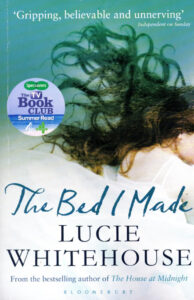 You just know this is going to be psychologically challenging.
The book? The Bed I Made, the second novel by Lucie Whitehouse, and a TV Bookclub Summer Read. (She has gone on to publish more since this one came out in 2010.)
Kate Gibson is on the Isle of Wight, running away from a dark time in her life, when she witnesses this chilling scenario. She’s a translator, so can do her work anywhere … but not if her mind is seething with conflicting emotions. Not if she’s feeling intimidated. Not when every noise in the night fills her with terror. Not when sinister things start to disturb her sense of security.
Richard Brookwood had swept her off her feet instantly when they met in a Soho bar; she’d given herself unreservedly. He was exciting, clever, ambitious, ruthless, rich, handsome, charming, intense, chaotic, challenging, competitive. And he knew exactly how to press her buttons. But now, eighteen months later, she’s doing all in her power to find a safe space away from everything connected with him, from every memory made with him …
… because what we had was not ordinary, there was a higher price for it.
And gradually, incident by incident, the truth begins to emerge from beneath layers of lies and half truths. Those chilling words echo in her head: ‘People have to learn that they can’t outsmart me.’
The attraction had been so strong, the protestations of love so fierce and swift. Then, when the fish was irrevocably hooked, it was payback time.
How could she have been so blind to the warning signs? How could she have made herself so vulnerable?
Whitehouse creates an unnerving story of control and psychopathological behaviour that maintains its tension, whilst leaving space for the reader’s suspicions to fluctuate, and the predator to stalk its prey, coming ever closer, merciless and determined. And through fiction we’re brought closer to the lived reality, and hopefully to more empathy for those caught in these toxic relationships – too many of which we hear about on the news too late.
New Year 2024
 As 2023 draws to a close and a New Year 2024 dawns, may it herald the start of much better things: More …
Kindness in a broken-hearted world.
Mercy where there is cruelty, oppression and injustice.
Light in the darkness of depression, loneliness and hopelessness.
Peace where there is conflict and hostility.
Love in place of greed and selfishness.
I send each and every one of you, whatever your circumstances, my very best wishes.