Anthony Doerr
About Grace is a literary novel by Anthony Doerr, author of the acclaimed All the Light We Cannot See. Was it of the same calibre? – that’s the question that drove me to buy a rather battered copy and read it.

It’s impossible to review it without some spoilers so please be warned if you intend to read it yourself. I’ve tried to keep them to a minimum.
David Winkler has always been different. From his youth he’s had presentiments, vivid dream-like experiences where he sees things happen which then come to pass: glass falling and breaking; a man being cut in two by a bus on an icy road; a young woman dropping a magazine in a supermarket.
So fixated is he by the vision of the young woman that he goes to the supermarket to watch her drop the magazine, and ends up marrying her (Sandy) even though she has already been married to Herman for 15 years. That union produced no children because Herman was infertile, so both Sandy and David are delighted when baby Grace is born.
As an hydrologist, David is obsessed by water and snow, and he’s increasingly disturbed by vivid nightmares about floods. His inherent sleepwalking escalates, taking him outside and even into water. But when the nightmares/premonitions are of Grace drowning in his arms as they’re submerged in flood waters, he is torn by indecision.
A fearful storm does indeed hit, and their house is flooded, just as he saw in his dream. Somewhere Grace is crying, just as predicted. As the water rises ever higher he is forced to make a choice; does he go into the house to rescue his daughter and be the instrument of her death as per the dream, or does he walk away and trust Sandy to save her? The tension is palpable. Is it even possible to hoodwink the powers that control our fates?
What if by leaving he had somehow tampered with the order of things, removed a thread and left the fabric snagged and incomplete?
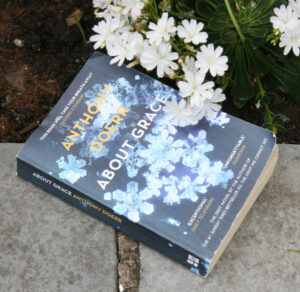 He does run away and takes ship far away to the Grenadine Islands in the Caribbean, but always at the back of his mind is the gnawing question: is Grace still alive? Sandy wants nothing more to do with him; as far as she’s concerned he’s a deserter; he’s dead. She even returns all his letters. He spirals to rock bottom: alone, destitute and bereft, surviving on what he can scavenge or scratch together by odd jobbing, almost drowning in a desperate attempt to take a ten-foot rowboat over a coral reef in tumultuous seas the night he receives Sandy’s note,
Don’t come back. Don’t even think of it.
But then he befriends a precocious girl with an obsessive interest in marine life, Naaliyah, who becomes something of a substitute for Grace. When he has a premonitory dream about her drowning with her ankle caught in the anchor chains of her boat, he begins to stalk her. In consequence he’s present when the accident does happen and thwarts the future by rescuing her.
Had he … was it possible … that he had changed the course of Grace’s fate too by his actions in much the same way?
And so it is that 25 years on, he sets out for Cleveland, Ohio, where it all happened. By now he’s 59. But his search is fraught with difficulties and eventually he finds himself in the frozen wastes of Camp Nowhere, off grid, in one of the most inhospitable parts of Alaska with Naaliyah. It’s here that Doerr excels; capturing the place, the life, the fight for survival, the power of love, eloquently and movingly.
But his story of one man’s battle with foresight, raises deep questions.
Where does reality begin and end?
Where are the boundaries and definitions – around dreams, nightmares, premonitory glimpses into the future, reality, sleepwalking, sentience …?
Is life preordained or do we have any control over our fate?
What is time? Must it be sequential, can it retreat, recycle?
Are events and meetings and love as prefigured and inevitable as the six sides of a snow crystal are honeycombed into its very atoms?
A literary work it may be, but I could at least understand it!! However, the pace is very measured; the main character is maddeningly slow; so if you’re anything like me you need to choose your moment to tackle this one.
So much more than a suspense novel
How’s this for an opening sentence:
I am serving the fifth year of a life sentence for murdering my own child.

Harlan Coben is one of those authors whose books I snap up when I see them and then titrate through the year when I’m looking for the indulgence of a sure-fire good read. He has more than eighty million in print worldwide so it’s not difficut! His suspense novel, I Will Find You, was my reward this week for an exceptionally frenetic time juggling lots of demands.
It exceeded expectation. Not only was it the usual juggernaut of tension and conflict, but it strayed into my own field of interest: medical ethics! The ins and outs of infertility treatment to be precise; informed consent; prolonging life v merciful death. Who knew?!
The narrator is David Burroughs. The child in question Matthew, aged 3, found dead in his bedroom, battered so severely that he’s unrecognisable. And the evidence against David is indeed compelling. In the house alone with his son. The worse for drink. Covered in Matthew’s blood. Known to have occasional violent outbursts and sleepwalking. A witness who states under oath that she saw him burying the murder weapon. His fingerprints the only ones on the handle.
When we meet him after five years in prison, Burroughs is reconciled to his fate. He is guilty after all – guilty of not having protected his precious son from whatever happened that night. He isolates himself; refuses to see visitors. Nothing of this horrific experience must further taint those he cares about. He loses touch with what’s happening in the outside world.
But then his sister-in-law, Rachel, insists on seeing him; absolutely insists. She brings with her a photograph taken by a friend at a theme park. The subjects in the foreground are a happy family enjoying innocent amusement, but in the background is a boy … a boy who looks uncannily like Matthew. It can’t be! It’s impossible. But … Against logic, hope stirs in David, and a renewed purpose is kindled. He has to find this boy … his boy … prove his own innocence … But first he has to achieve the impossible: find a way of escaping prison.
The developments that follow keep the reader in a state of high tension, willing him to stay ahead of the authorities, as he searches out those who might lead him to his boy, those who were involved in some way in framing him, and whoever it was who killed the lad lying in that bed that night wearing Matthew’s Marvel-hero-themed pyjamas.
Wordsworth remembered
 The Lake District is a spectacularly beautiful part of the British Isles, especially in my opinion, in autumn.The colours are fabulous, and I enjoyed them enormously this week, despite the record amount of water everywhere, including extensive flooding of the roads. So I’m not surprised that the area inspired the poet William Wordsworth to write some of the best known lines in the English language. And it was a real thrill to visit his home, Dove Cottage, now a memorial to him, with an excellent museum and stunning special exhibition.

William was relatively unknown when, in 1799, he arrived aged 29 and set up house with his beloved sister Dorothy in the modest cottage in Grasmere. She remained with him when he went on to marry his wife Mary, (a childhood friend) and their five children came along. Two of the five sadly died in infancy and this profoundly affected the poet. So deep was the effect of the unremitting grief for his youngest, Catherine, that he was taken aback when he felt a moment of happiness. He turned to share the joy with his ‘heart’s best treasure’ only to remember she was ‘buried in the silent tomb’. That experience inspired Surprised by Joy, published three years after her death.
The two women, Dorothy and Mary, played a pivotal role in his life and work. Dorothy was a thinker, writer and diarist in her own right, and she especially contributed ideas and beautiful language as well as practical support for her more famous brother.
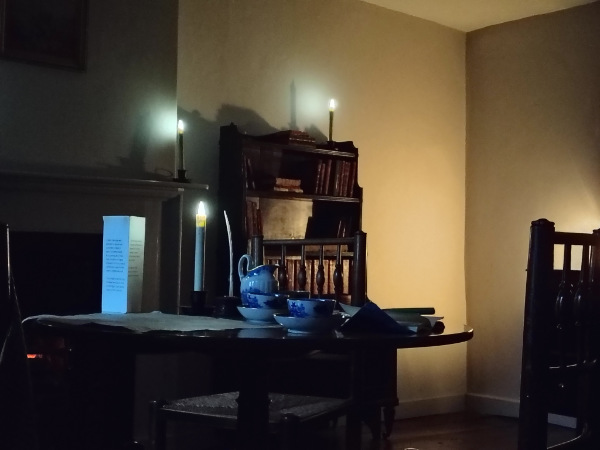
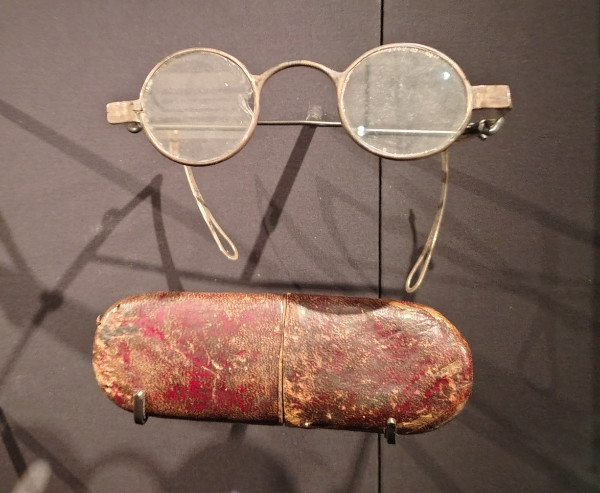
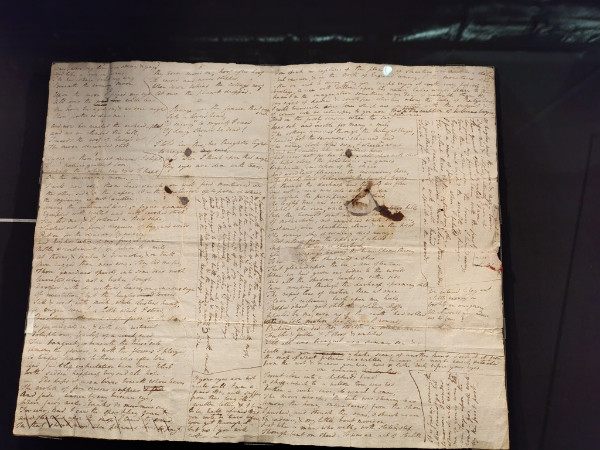 By his own admission William’s writing was ‘mangled and almost illegible’, so both women paintakingly copied his work legibly all by hand with a quill pen in poor light to make it fit to submit. There’s dedication for you! The house today is kept lit by candles and shaded lanterns, as it would have been, and it’s a struggle, even with the benefit of our modern spectacles, to see the tiny print of newspapers or books and diaries in which they recorded their thoughts.
Wordsworth was also a deep and sensitive thinker and, though he was writing three centuries ago, many of his ideas resonate with us today. He calls us to reconnect with nature; to show empathy for others; to nurture our creative imaginations; to live and do good. Throughout his life he wrote a reflective poem about his own experiences and cogitations, a monumental work, The Prelude, which ran to 7,898 lines! It was published three months after his death at the age of 80, by which time his copy-editors (Mary and Dorothy) had inscribed 20,000 lines spread over 5 decades! And it was William who was paranoid about his own eyesight!!
Nowadays this man is revered as one of the greats in English literature – who hasn’t heard of his host of golden daffodils?! – but there was a point in 1807 when reviews of his poems were so savage – ‘nauseating’, ‘dull’, ‘downright raving’, ‘such trash as this’ – that he couldn’t face publishing another volume of poems for 7 years!
Fortunately he overcame the criticism and his name lives on, though his detractors have vanished without trace! Let that be a lesson to all of us who venture to put our thoughts above the parapet.
On that best portion of a good man’s life
His little, nameless, unremembered acts
Of kindness and of love
Persisting against the odds
As I said last week, no reading is totally wasted on a writer. And it’s on that basis and in that spirit that I’m sharing a couple of books which I haven’t particularly enjoyed, but which taught me something, including respect for extremely talented authors who know just how to create and maintain suspense and conflict. Perhaps at this point I should come clean and admit that I’m not a fan of violence or torture in fiction, which definitely colours my reactions to certain genres of writing, but I’m also very aware that I can’t afford to be naive and stick my head in the sand.

I’ve written positively about James Patterson‘s psychological thrillers in the past, especially his series featuring Alex Cross, a psychologist and police detective – the why of it all intrigues me. So Target (Alex Cross) jumped out at me. It features the death of a female President of the USA, closely followed by the assassination of a whole raft of Senators and other politicians who are in line to take over running the country, not to mention a few other bodies who might loosely be described as collateral damage. Hmm, the advice ‘suspend disbelief ‘comes to mind!
It’s incredibly complicated plotting, simultaneously following a number of different assassins as well as assorted investigative agents and teams struggling to connect the dots and track down both the perpetrators and their masters. The deaths are gruesome, the cold detached disregard for life chilling, but I could respect the mind behind the tale, holding together so many threads, weaving in so much technical detail, and even slipping in a tug at the heartstrings when one couple become assassins to make enough money to take their dying son abroad for cutting-edge therapy. Though I found aspects of the book barely credible, I have to recognise this as story-telling at a high level of complexity and skill.

Harder to stomach though, was In Too Deep by Lee Child and Andrew Child. Lee Child’s protagonist, Jack Reacher, was known to me by name but I hadn’t made his acquaintance, so I fished In Too Deep out of a tub of discounted books in a charity shop, to fill that gap. Well, I needed all my wits about me for this one, and I still floundered at times.
The story begins with Reacher himself suffering serious injuries in a car accident – broken wrist, concussion, severe headaches and blurred vision. Not, you might suppose, in any fit state to be solving complex crimes or chasing dangerous armed criminals. The first half of the book is told with parallel stories in sections within chapters: one stream about Reacher defying the odds despite his injuries, trying to outwit a ruthless gang of crooks, some of whom remain unnamed just to further complicate identification; the other stream following the crooks trying to pull off a major heist, outwit the authorities, and threaten world peace and safety, all with backstabbing a-plenty to confuse me still further. Oh, and goodies and baddies are apt to change sides. Fries my brain! But overall, I guess its biggest value was in identifying the things I don’t like in fiction.
Hey, I persevered, and softened the experience by keeping the needles flying with the Christmas knitting as I read.
The Wedding Guest
Writing about some of the best-known detectives in crime fiction recently got me thinking about others that didn’t instantly spring to mind. Cue LAPD Lieutenant Milo Sturgis with his sidekick psychologist Dr Alex Delaware, creations from the mind of Jonathan Kellerman (himself a psychologist as well as best-selling novelist). It will come as no surprise that psychology is closer to my field of interest than crime, so I’ve enjoyed previous books in the series where Delaware shares his insights as a first person narrator.

And what d’you know, there on my tbr shelf was an unread volume featuring this duo picked up in a charity shop recently: The Wedding Guest.
The scene is a wedding reception with a Saints and Sinners theme in a rather seedy venue that used to be a strip club. A pathologically self-centred bride and a wimpish groom do nothing to endear the tale to us. Then one of the bridesmaids discovers the body of a beautiful young woman draped over the cistern in a grotty backroom toilet, a stranger whom no one in the party recognises. There are no means of identification on her and we don’t discover who she is till almost exactly half way through the book.
It’s an easy read with a linear story line but I confess the plot of this one didn’t appeal and I really didn’t care about any of the characters.  However, I’m mentioning it because it serves to remind me that there are many facets of writing which can be valuable, even those we thoroughly dislike. In this case one thing Kellerman does do well is dialogue. Whether it’s the easy banter between Delaware and Sturgis, or the obfuscation and incriminating cues dropped by those with something to hide, or the coded exchanges of colleagues, they drive the narrative on and flesh out the characters.
As the saying goes, no reading is wasted for a writer.
Rest and recreation
Even part-time writers need a break for rest and recreation occasionally! So, what fitted the bill for me? A week in Croatia, along the Dalmatian coast.
Sunshine – warmth, deep blue skies, stunning sunsets.

Beauty – crystal clear seas, shady walks, waterfalls.

 Tranquillity – secluded parks, pretty islands, still waters.

History – medieval streets, ancient buildings.


Distraction – exploring, learning about a very different way of life from local guides enthusing about the cities they love.


Amusement!

Switching off – forgetting for a few days the news, current issues, responsibilities.

Just what the doctor ordered.

Oh, and a suspenseful book that leant itself to occasional perusal in spare moments, holding my interest for the week: Along Came a Spider – introducing psychologist/detective Alex Cross.

Guilt and grief
For those of you who don’t know much about me, death and grief were subjects I studied for many years in my professional career. So I was instantly intrigued by the blurb about the novel Without Mercy by acclaimed Dutch author Renate Dorrestein (translated by Hester Velmans).
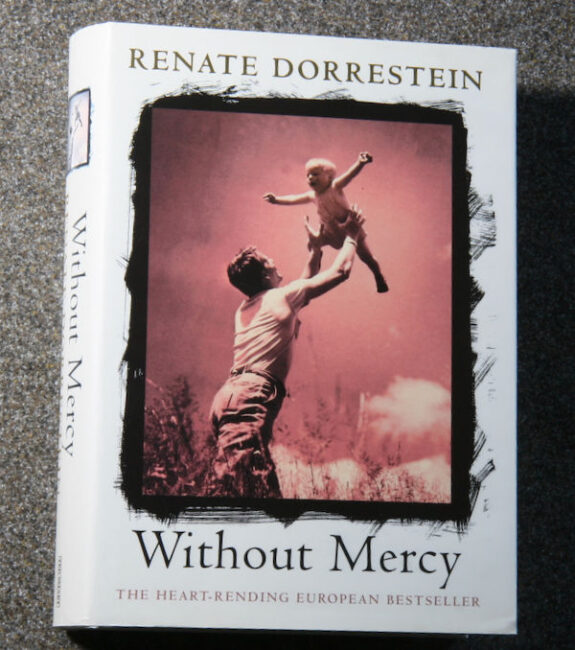
Franka and Phinus have the perfect marriage. Until one single senseless act loses them their only child, the perfect teenager Jem. And loses them their ability to talk to each other. Franka loses her power to sleep, and Phinus his former gentleness, combating his grief and secret guilt with obsessive thoughts of revenge.
Phinus was an orphan from an early age brought up by two elderly aunts, and tales of his childhood are woven alongside those of Jem’s early years. Franka’s first husband, Jem’s father, died in a car accident before their son was born and Phinus has been the only father Jem knows. He adores the boy. Jem’s death in a senseless shooting sends both parents into a spiral of grief and despair and they eventually decide to go away for a break together to try to retrieve something of their old close relationship. But things don’t go at all to plan.
It’s a literary novel but one that I actually understood and valued. Wahey! A triumph in itself!
Clearly identifiable and authentic aspects of grief include the problems of …
parents grieving at different speeds and in different ways
living with endless painful reminders
the impossibility of saying the right thing
the clash of different grieving strategies
haunting and corrosive guilt and regret
misinterpretation of words and behaviours
lashing out
self- damage
finding a pathway to acceptance of irreversible loss.
On the other hand, I wasn’t personally convinced by some of Phinus’ wildest behaviours -–sexual or violent – and I regretted the number of threads left unresolved. But it is beautifully written/translated.
 In perfectly chosen expressions Dorrestein captures the ongoing sense of unreality:
waiting behind every door was the shock of emptiness
And the knock-on effect:
ruined lives – the ripple effects – circle upon concentric circle
I loved the description of two teenagers Phinus encountered on a bridge:
graffiti made flesh
Overall then, a moving book full of thought-provoking challenges about fathomless loss and never-ending yearning following the death of a child.
Journal roundup
A few reflections from the annual roundup of wisdom and challenges in the writing journal, Mslexia.

Reading about other writers’ experiences and tips, studying the short stories and poems that win competitions, helps me identify my own strengths and weaknesses. And every year confirms my own inability to comprehend the art of short fiction or poetry!
It also reminds me that in order to get full-length novels accepted and promoted and marketed you need the persistence of a terrier, the hide of a rhinocerus, and the confidence (?pedigree) of a thoroughbred horse. At least the goalposts were there for non-fiction which I had relative success with. But when it comes to the world of fiction … goalposts? What goalposts?! Perfection is always another draft away.

It’s an ongoing personal challenge, but I can at least share a few gems that really resonated:
Striving for perfection will trample your happiness as a writer faster than anything else. The pressure we put ourselves under is exhausting. And it’s unsustainable.
Sian Meades-Williams
In assessing the quality of a story there are five elements that must be satisfied:
Characterisation: the ability to bring realistic, consistent, multi-dimensional people to the page.
Shape: the relationship between idea and form and the ability to pace the story, the interplay between background context and forward motion, to end with meaning,
Technical ability: the guts of a sentence well constructed.
Voice: musicality, tone and vocabulary,
Spirit: passion made concrete, gumption, spark. Fiction confidently expressing truth.
Leone Ross
At its heart, feeling successful is about fulfilling a commitment you have made – to yourself, to your creativity, to your project.
Safiya Robinson
Dissatisfaction is a writer’s greatest gift.
Elle Nash
Onwards and upwards!
Detective work par excellence
 I don’t know about you, but I’m in awe of authors who manage to juggle with characters in whole series of books, developing their life arc and maintaining tension in their personal circumstances, whilst hatching new plot lines and introducing misleading clues and assorted other players, without dropping a ball.
In a recent interview, Jacqueline Wilson talked about reprising some of her teenage characters now as adults and some of the caveats which mean that Tracy Beaker herself was probably not doable. But there are plenty of famous fictional detectives who grow older and grapple with domestic issues alongside their masterful sleuthing – Rebus, Wexford, Dalgliesh, Holmes, Poirot, Miss Marple, spring instantly to mind.
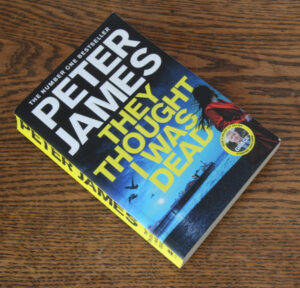 However, I was gobsmacked to pick up the twentieth book featuring famous detective, Roy Grace, only to find Peter James finally, finally answers the big mystery in his character’s life.
When he was creating the character of Roy Grace in Dead Simple back in 2003, James wanted to give his principal protagonist an edge that would set him apart from the clichéd detectives – with a drink problem, substance abuse, relationship issues. Conscious that above all else, detectives solve puzzles, he gave his detective a huge ongoing puzzle.
On his 30th birthday Roy comes home from work and finds Sandy, the wife he adores, has vanished. Her car is found abandoned in the short-term car park at Gatwick airport. Otherwise there is no trace of her. Originally the author had planned to reveal the truth about her in the second book in the series, Looking Good Dead, but he found readers and fans loved to speculate about her fate, and engagement with the mystery of her whereabouts hugely increased sales. So he kept deferring the denouement.
Twenty-one years and nineteen books later he finally tells her story in They Thought I was Dead… twenty-one years!
In the foreword he asks us to try not to be too harsh in our judgement of Sandy. I fear I was. But much more significantly, I am lost in admiration for someone who can keep all those threads and hints and mentions sustained throughout. OK, he had someone else do a consistency check or two as well, but his was the brain and hand behind the enterprise. A bit like the meticulous work of Detective Superintendent Grace himself, huh?
Finding freedom
 Edith Eger, a Czechoslovakian Jew, was only sixteen when, in 1944, she was deported to Auschwitz. She was sent on death marches and into forced slave labour, where she endured unimaginable horrors, starvation and brutality. She was made a human shield for Nazi ammunition in a thin striped dress lying on top of German trains. And finally, emaciated and infested, she was left for dead in a pile of bodies.
After her liberation it took years for her to work through the trauma and damage and guilt, overcoming enormous obstacles – both external and internal – to become an acclaimed psychologist and psychotherapist.

Her book,The Choice, (written with co-author, Esme Schwall Weigand) is not simply another account of survival during the Holocaust. That’s a profound and powerful part of it, but Dr Eger weaves her own personal experiences together with clinical cases where, in her professional capacity, she has used the wisdom she gained to help her patients to confront their suffering and free themselves from the shackles that imprison their minds. And in the process she finds her own redemption.
She writes stories:
…stories of choices, big and small, that can lead us from trauma to triumph, from darkness to light, from imprisonment to freedom.
She shares deep and wise insights:
Suffering is universal. Victimhood is optional.
There is no hierarchy of suffering.
Our painful experiences aren’t a liability – they’re a gift. They give us perspective and meaning, an opportunity to find our unique purpose and our strength.
It’s not what happens that matters – it’s what you do with it.
She has high ambitions:
…to help you escape the concentration camp of your own mind and become the person you were meant to be.
…to experience freedom from the past, freedom from failures and fears, freedom from anger and mistakes, freedom from regret and unresolved grief – and the freedom to enjoy the full, rich feast of life.
She knows her own limitations:
Overcome? I haven’t overcome anything. Every beating, bombing, selection line, every death, every column of smoke pushing skyward, every moment of terror when I thought it was the end – these live on in me, in my memories and my nightmares. The past isn’t gone. It isn’t transcended or exised. It lives on in me. But so does the perspective it has afforded me: that I lived to see liberation because I kept hope alive in my heart. That I lived to see freedom because I learned to forgive.
She has arrived at a most important perspective:
…the biggest prison is in your own mind, and in your pocket you already hold the key: the willingness to take absolute responsibility for your life; the willingness to risk; the willingness to release yourself from judgment and reclaim your innocence, accepting and loving yourself for who you really are – human, imperfect, and whole.
Revisiting Auschwitz, she discovers a profound anomaly:
This is the geometry of systematic torture and death. Mathematical annihilation.
The immensity crushes.
There is no language that can explain the systematic inhumanity of this human-made death factory.
Here in the world’s biggest cemetery there is not one single grave.

A colleague, Professor Philip Zimbardo, sums up the reach of The Choice:
…extraordinary chronicle of heroism and healing, resiliency and compassion, survival with dignity, mental toughness, and moral courage. All of us can learn from Dr Eger’s inspiring cases and riveting personal story to heal our own lives.