Home Sweet Murder
Best-selling author James Patterson admits that he is most inspired by real life, it being stranger than fiction. And he demonstrates that potential with the crimes reported in Home Sweet Murder which are 100% real, although certain elements of them have been fictionalised for narrative flow.

From the outset Patterson declares himself still haunted by the accounts in this book, and I can totally understand that – the attacks he details are truly barbaric, and turned the stomach of even the most experienced law-enforcement officers. A horrible reminder of the human capacity for unspeakable violence and depravity.
There are two stories told in this volume, both revolving around revenge for perceived wrongs.
In the first case, a senior lawyer and his wife, both in their sixties, are targetted in their own home. A man in a suit purporting to be an SEC agent, calls at their house one Sunday night, and interrogates Leo Fisher about irregularies in his legal firm. When Leo doesn’t reveal any incriminating information the intruder escalates the aggression, shooting, slashing, hitting, stabbing, kicking, until both his victims are close to death. He then pours gasoline around the house. But before he can light it, the office alarm is triggered and he flees with his accomplice – his wife. Despite his parlous state, Leo recognises the woman and is sufficiently aware to give the police a name, and one of his former employees, dismissed for rank incompetence and fraud, together with her husband, are apprehended. Though both Leo and Sue survive, the effect of the experience and their severe injuries leave indelible scars which will never heal. Even answering the doorbell is now an ordeal.
The second case involves a pathologist and university professor, William Hunter, and his eleven-year-old son, Tom. William arrives home one day to find his housekeeper lying lifeless in a pool of blood, and his son dead on the floor, both with kitchen knives sticking out of their necks. The wounds are eerily neat and precise; and what’s more, made by the Hunters’ own de-luxe kitchen knives. Who could possibly have the motive to kill a young child and a grandmother? A paedophile? A gamer? A monster? Who?
Five years pass, five long frustrating years for the police going over and over the evidence and the baffling apparent lack of motive. Detectives Mois and Negron are still searching when another doctor, Dr Brumback, a pathologist from the same university as Dr Hunter, and his wife, are murdered and left with their own kitchen knives protruding from their necks. On Mothers’ Day.
The focus is now on someone connected to the two doctors; someone with the skill to find specific veins and arteries in the neck, who might bear a grudge serious enough to kill. The team hunt through innumerable personnel files from the university. A former employee with a disastrous track record emerges as front-runner: Anthony Garcia had tried to sabotage a colleague’s medical exam; was rude, aggressive, professionally lax; had failed to gain a licence to practice; was fired (by Dr Hunter) and then denied a recommendation again and again (by both Drs Hunter and Brumback). But this is devastating news for Will Hunter himself. His beloved son, his housekeeper, his colleague, and his colleague’s wife have all been murdered because of his interactions with a disgruntled employee. But the net inexorably closes around Garcia, thankfully before he can cross the last two potential victims’ names off his hit list.
I was surprised to see how clumsy some of the prose was in places in the first half, but in spite of that, these stories are compelling reading. And especially chilling given that this is real life crime, not fiction. Patterson knows exactly what makes for a gripping tale and how to tell it.
Serious reading for 2026
I’ve been ploughing through a pile of crime-related books recently (reviews pending) so, by way of a reality check, I thought I should reassure you that I haven’t gone totally over to the dark side!
As regular visitors will know, for some years now I’ve chosen a serious topic to study for the 12 months, alongside all my other reading – something that I’m curious about, or feel I don’t understand. Something to challenge pre-conceived ideas hopefully; sort the wheat from the chaff.
This year I’ve chosen to look into prayer. What is it? How does it work … if it does work? Is it relevant or valuable? What difference does it make? That kind of thing.

So I’ve started on the first raft of books, maintaining focus by putting ideas and questions into a document. Strange how, once you start with a topic, all sorts of serendipitous ideas pop up everywhere … memes, blog posts, snippets on social media. Seems like it’s something lots of folk are thinking about. And with terribly dark things happening in our known finite world, lots of people are appealing to an unseen, only-partially-known, infinite Being for help. Are they right/wise to do so?
13 hours locked in a psychiatric unit
When I was about 20 I was faced with a choice of rotation: obstetrics or psychiatry. It was a no-brainer for me; I was only too aware of the fine dividing line between mental health and mental illness. My vivid imagination played into this decision too.
I grew up in the country in Cornwall not far from the River Tamar. On the other side of the river, on Dartmoor in Devon, was a prison, and very occasionally one of the inmates would escape. I was convinced every owl hoot was them sending signals to their co-conspirators! I couldn’t scuttle the mile home along an unlit path in the gloomy light fast enough. I lay quivering under the bedcovers at night. And I’ve had wierd inexplicable experiences that hover in a twilight zone on and off ever since.
During my decades of clinical practice, I encountered real patients with real mental illness, and visited good friends who needed inpatient treatment for a time. Effective management has changed dramatically over the years, but there’s still for me a scary element of there-but-for-the-grace-of-God … The margins feel all too fragile.
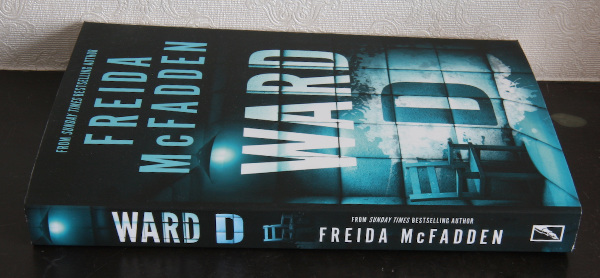
So, last week I picked up a thriller, Ward D, about a psychiatric unit, with a degree of trepidation. Should I get it … should I not? My curiosity overcame my demons and not only did I buy it, but I deliberately put it on the top of my tbr pile. Better not keep procrastinating or I might never dare to open it!
The author, Freida McFadden, is herself a physician specialising in brain injury; her father a practising psychiatrist. She’s a very successful novelist too with accolades in the world of thriller writing, so her credentials are excellent. This should at least be authentic … or is it?
Ward D is a primary locked psychiatric unit. Medical student Amy Brenner is currently rotated to psychiatrics, although she knows she’ll never choose that specialty. Never. Ever. Like me, she’s acutely conscious of the fine line. Almost ten years before, her best friend had been an inpatient there and Amy came face to face with the fragility of the human mind. Hers included. Most especially hers. Because she’d started to hallucinate and hear a voice telling her to do bad things.
 She’s already completed the outpatient bit of her rotation but now she’s scheduled to do one 13-hour night shift in Ward D. Just one night. One night. But for 13 hours she’ll be locked in with seriously disturbed patients and a skeleton staff. She’s frankly terrified, and that feeling only increases when she’s told that two rooms are reserved for the most dangerous patients, one of which is occupied. On no account must she unlock that door. The noises that emanate from behind it are bloodcurdling enough.
The story is written with two time frames. One takes us back eight years to Amy’s friendship at school with Jade, a girl from a troubled home, who develops mental illness sufficiently serious to need incarceration in Ward D for a time. The other, set in the present, counts down the 13 hours of Amy’s night shift as inexplicable things start to happen, terror mounts, and she begins to doubt everyone and everything. The patients have histories of violence but roam around the unit at will, some of them warning her she will be killed that night. A fellow medical student suddenly vanishes from the unit. Even the experienced doctor and nurse she’s working with seem suspect. Who can she trust? But not only is she locked in with them, she has no means of connecting with the outside world, and when a patient manages to damage the electrics, not even a code to allow her to get out.
What actually happens is so extreme I could detach myself from the action for much of the time; it’s inconceivable that this could actually happen. But it was still a tense read.
I did finish it – honestly I did! But perhaps the most sobering message I took from it was that, no matter the severity of the illness or the crimes such patients might commit, they are nevertheless human beings first.
The Night Gate: Peter May
I do love a main protagonist in a series to exhibit unusual characteristics. Peter May‘s forensic expert, Enzo Macleod, has a white stripe in his dark hair running back from one side of his forehead, and one brown eye, one blue eye – both physical manifestations of Waardenburg syndrome. The faulty gene has skipped a generation but reappeared in one of his grandsons as hearing issues. What kind of a mind conjures up something as obscure as that?! Love it. And it’s only one of many trademarks that single this author out as exceptional. I’m a big fan.
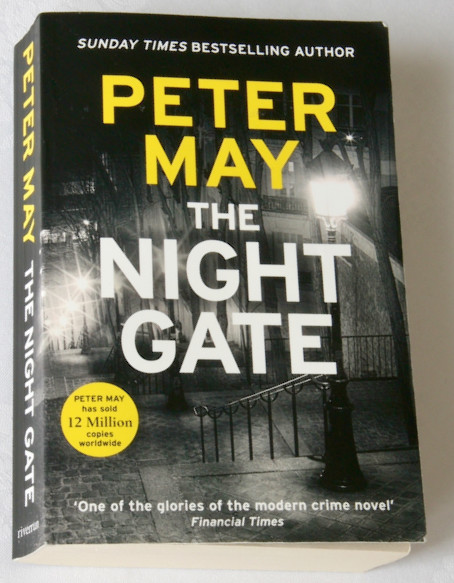
Another skill he excels at is evoking different places in different countries. In The Night Gate, we flip from Scotland to France to Germany by means of deft descriptions and a few local words. From the desolate windy shores of the Outer Hebrides to the dusty heat and rural charm of the Occitanie region in SW France, we’re in the hands of a writer who knows where he is.
By now, Macleod is officially retired, but missing the challenge and buzz of his old job. So he can’t resist a request to consult on two murders which have been discovered in a tiny medieval village, Carennac, on the banks of the river Dordogne. One is 75 years or more old: a storm has uprooted a tree and its roots have lifted a tangle of bones and leather and assorted remains of a ranking officer of the Luftwaffe with a bullet hole in his skull. The other is contemporary: it’s the 2020s, pandemic time, and Emile Narcisse, an art dealer from Paris, is found with his throat cut in the rustic kitchen of an elderly woman, Anny Lavigne, in the same village as the WW2 German’s body was discovered.
Immediately suspect for the fresh murder is Hans Bauer, a young German in his twenties, director of a small private art gallery in Germany, who has a history of violent outbursts, and is known to have visted the old lady that day. And incriminating evidence is indeed found placing him at the scene of the murder. But just what is his connection to both these bodies? It all seems too coincidental, and Enzo hates coincidences. So he begins to dig deeper.
The dead man, Narcisse, he discovers, was phenomenally wealthy, a huge name in the world of international art, who came to public recognition when he uncovered a haul of looted Nazi art in an apartment in Geneva, Switzerland. He’d done all he could to return the priceless works to their rightful owners, and where no heirs existed, sell them to museums and art galleries or private collectors. So what had brought a man such as Narcisse to the modest home of an old lady in a tiny backwater village in south-west France?
It’s Anny Lavigne who provides valuable insights which fill in the backstory to the historic case. She tells Enzo so much about what happened in occupied France in the 1940s; a story she’d heard time and again from her mother. How Hitler commandeered an art historian, Paul Lange, to procure the most famous painting in the world, the Mona Lisa, and hide it somewhere until after the war, when it would be given pride of place in the museum Hitler planned to have built in his hometown Linz in Austria. How General de Gaulle knew of this plan and enlisted the help of another art historian, half-French Georgette Pignal, who had personally helped to pack the precious painting and send it into the country for safekeeping from the Germans. Now she was being given full responsibility for guarding it, but she was to tell no one.
 So she’s shocked to discover that Paul Lange, now a German officer, knows exactly what her mission is. She feels nothing but hostility towards him, but he appears unoffended, even mildly amused by her blatant venom and embarassment at being seen in his company. However, her bosses instruct her not to cause any offence to the Germans, so she reluctantly agrees to being wined and dined every Friday night by Lange. He proves himself to be always the gentleman, making no effort to seduce her, and gradually she learns to trust him.
But others too have designs on the famous painting and we get sucked into an increasingly complex vortex of desire and greed and subterfuge. Who will acquire it? And at what cost to those who thwart them?
The fact that so much of the backstory is historically accurate gives added heft and credibility to this tale: the evacuation of art from the Louvre during WW2 to various chateaux around France; the appropriation of countless works of art by the Germans, including burning some of the canvasses; the courage of named individuals in cataloguing the stolen paintings and tracking them down in order to restore them to their rightful owners after the war; the bravery of the resistance fighters. And the cost in lives.
The plotting is tightly and unerringly woven like an underground map with tracks and links and connections steering the reader to a powerful conclusion. And through it all Peter May drops his trademark literary gems which make his writing sing.
Leaves fell like snow in his headlights. September was stating its case for an early winter.
Depression fell over her like a shroud shaken free of its folds, black and all-enveloping.
Moonlight bled through stained glass to sprinkle dead light among the pews.
Compelling, thrilling, and one to haunt me for some time to come.
New year 2026
 This coming year …
May truth be valued and lies decried
May compassion eliminate cruelty and cowardice
May hope return to the disenfranchised and lost
May wisdom guide both leaders and those who are led
May peace be the goal of all nations and all people
May the power of love be stronger than the love of power
For last year’s words belong to last year’s language
And next year’s words await another voice
TS Eliot

Psychopaths, Savages and Monsters
Last week I dipped into the world of carers who kill, and wondered what possesses someone to savagely murder those in their care for apparently base motives. It seems incomprehensible.  So when I saw Talking with Psychopaths: A Journey into the Evil Mind I bought it, hoping to get a better understanding.
And indeed this book is … a road trip into the deeply disturbing and darkest recesses, the abyss of the minds of psychopaths and savages … alongside a criminologist, Christopher Berry-Dee. Berry-Dee has spent decades interviewing and corresponding with some of the most notorious psychopaths of our time, and written a string of books on the topic. He agrees that it’s a bizarre, scarcely credible world where elephants fly, lead balls bounce and fairies reign supreme.
So what does he reveal about psychopathology?
There are specific psychological assessment tools which can determine whether someone is a psychopath or not. Although it’s important to bear in mind that not all psychopaths go on to commit terrible crimes – many indeed become quite successful in life because of their glibness and charm and willingness to ride roughshod over the people in their way.
Berry-Dee includes these characteristics as diagnostic:
over-inflated egos and exaggerated feelings of self-importance
narcissistic, pumped full of self-esteem
excessively dependent on admiration from others
cold, remote, indifferent to the plight of others, hostile even
cunning, manipulative
pathological liar
no conscience
(Relevant to last week’s post, he says Narcissistic Personality Disorder is inextricably linked to psychopathy.)
Because a psychopath is defined by clinical concepts it could be argued that he/she is suffering from a condition that is beyond his overall control. The savage has no such excuse.
It is only those who combine brutal violence with an animalistic disregard for any rules of human behaviour who can be called savages.
The author writes about both together, and the catalogue of murderers he includes seems to warrant this link: Oscar Pistorius (paralympian who shot his girlfriend), Harold Shipman (family doctor who killed at least 215 patients), Kenneth Alessio Bianchi (aka the Hillside Strangler, who kidnapped, raped, tortured, and murdered 10 girls and young women), Peter Sutcliffe (aka the Yorkshire Ripper, who murdered 13 women) to name but four well known to us.
The accounts highlight the ability of these dangerous criminals to manipulate and hoodwink and cleverly manipulate people and events to serve their own ends, often evading detection or capture for years. And it’s utterly chilling to see this cleverness sometimes resulting in release from custody, only for the monster to kill again. In one case indeed, Arthur Shawcross – reckoned amongst correctional officers to be a highly dangerous and formidable killing machine – was nevertheless released 10 years before his full 25-year-tariff had been served, only to go on and murder at least nine other women in the space of 21 months. Kenneth McDuff killed again just three days after his release following 23 years in jail for sadistically murdering three teenagers.
One conclusion that I found seriously disturbing is that experts in the field often disagree on fundamental points, and yet their assessments are used to inform decisions about just what should be done with these highly dangerous psychopaths. Indeed, both psychiatry and criminology seem to be very imprecise sciences. For every theory posited, someone else knocks it down. The author of this book demolishes many a case made by his professional colleagues. So, though the theories offered seem plausible, for me the jury remain out on many points. I’m simply not in a position to discern for myself.
It must change a normal person to spend long hours over many years with such depraved men, and that might well explain the tone and language of this book. But I personally found it distasteful to have the author blowing his own trumpet quite so often, repeatedly promoting his own books. And the rather unprofessional sarcasm, flippancy, colourful derogatory language, or snide slights in places.
But as he says himself: entering into the mind of a fully emerged psychopath – it’s not a good place to be. And when all’s said and done, it can’t be easy knowing that one can use all of the psychopath tests ever invented but one cannot spot a psychopath until – most especially in the cases of homicidal psychopaths – it is far too late. That awareness, coupled with all the horrific cases that hit the headlines after the event, must leave their mark. It’s not a world I would want to frequent. I was relieved to close this book and shelve it.
Carers who kill
I’ve reported on this blog high profile cases of health care professionals suspected, then accused, and then convicted of killing those in their care. Doctors like Harold Shipman, and nurses Beverley Allitt and Lucy Letby, spring instantly to mind. Rare but particularly disturbing, because there’s something uniquely chilling and repugnant about people in the caring professions actually harming those who trust them implicitly – the vulnerable, the frail, the disabled, the elderly.
 When I researched material to inform my novel Killing me Gently, which involves someone deliberately and systematically harming a baby, I found it very unsettling to glimpse inside a brain capable of doing such a thing, so alien to every instinct we all feel to protect and safeguard children. So I was curious to see STV were airing a series under the title Nurses who Kill.
But first I’d take issue with the title. Using the term ‘nurses’ is misleading. Only three of the ten killers are actually nurses. The rest are carers – both professional and informal; one is a paramedic. Not nurses. Their methods cover arson, vicious and sustained bludgeoning, using medical skills to kill rather than cure.
Each story is told through the lens of those most closely involved – relatives, acquaintances, detectives, policemen; and a range of experts – lawyers, criminologist, journalists, doctors, forensic psychologist, reporters, researchers, those appointed to safeguard the vulnerable. Giving a well rounded and fair account.
It’s perhaps not surprising that debt and theft feature strongly. Indeed money and greed lie at the root of most of the cases. A forensic psychologist who reviewed all the cases describes immature personalities, narcissism, egocentrism, contributing to their aberrant behaviours. Mercifully most are in no position to do any more harm, and we can only hope the families of the victims have found some consolation in that.
My advice: Choose your moment to view such depressing footage.
A cautionary tale
For some months now I’ve been receiving three kinds of emails designed to appeal to my ego but that actually engender disquiet and annoyance. Often several a week.
 The first kind, addressed formally to my professional name, purport to come from professional journals or organisations, lauding my work and my global contribution to science, before inviting me to accept an invitation to speak at their conference (often the keynote address), or to contribute to an upcoming edition of their organisation’s publication. Not only did I leave that world many many years ago, but no one could possibly be a leading authority on such a vast array of topics! But worse is to come. Sometimes, when I ignore such messages (as I invariably do), I then get quite threatening follow-up contacts decrying my want of manners or integrity, putting more pressure on me to agree to their requests!

The second kind are more matey, and appear to come from website designers, praising my prolific output and high profile but drawing attention to the potential for a much wider and more lucrative reach. There is, it’s true, room for improvement in my website, some truth in their analysis, but I have a professional designer, and no amount of flattery can be allowed to influence me to fall into these traps.
The third kind is the most insidious. It is very gratifying to get long detailed messages praising my medical ethics novels to the skies; emails that analyse my stories impressively accurately, and use superlatives to describe how they plumb emotional depths, capture profound truths, provoke deep exploration of human experiences, and could set the reading thinking world on fire … if only I would liaise with the sender to reach the millions hungry for these very books. No mention of money in the first approach, needless to say.

I confess I have a lot of sympathy with those who fall for such scams that are so rife nowadays. When the first one arrived with a brilliant synopsis of one of my novels, I was initially sufficiently intrigued as to reply with a list of questions as to motive and expectation. The contact soon went dead! Whatever means are used – AI is way beyond my pay grade – it would be all too easy for be sucked in to these lures designed so cleverly to stroke the ego and offer untold fame and fortune. I’m sharing these thoughts in the hope that it might just save one unsuspecting and trusting innocent going quietly about their own business, the humiliation and damage done by being duped and then fleeced.
As the saying goes: if it looks too good to be true, it almost certainly is too good to be true.
Beloved
Beloved by Toni Morrison was published way back in 1987, and won the Pulitzer Prize the following year, but to my shame, I must confess, I’ve only just got around to reading it.
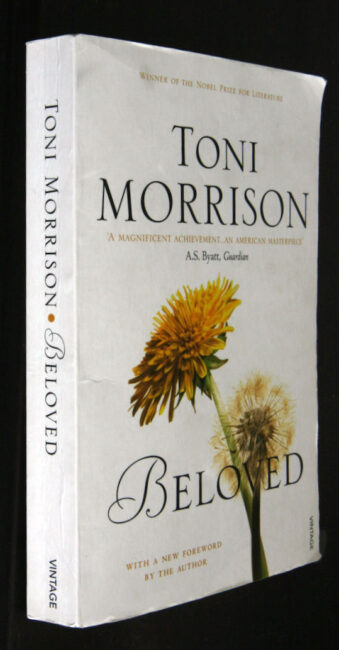
Nowadays it would be regarded as very un-pc, but it movingly captures a bygone era in the 1800s when slavery was rampant in America, and a vast gulf separated white from black. But the fact that it’s written from the perspective of the slaves themselves, with their African-American folklore and magical beliefs, dialect, and colloquial names, seems to render the ‘unacceptable’ language somewhat less offensive. It’s of its time and place and culture.
Morrison rather likes lists that sum up characteristics, and her description of life in 1875 captures something of the horrors:
Whole towns wiped clean of Negroes; eighty-seven lynchings in one year alone in Kentucky; four colored schools burned to the ground; grown men whipped like children; children whipped ike adults; black women raped by the crew; property taken, necks broken. He smelled skin, skin and hot blood. The skin was one thing, but human blood cooked in a lynch fire was a whole other thing. The stench stank.
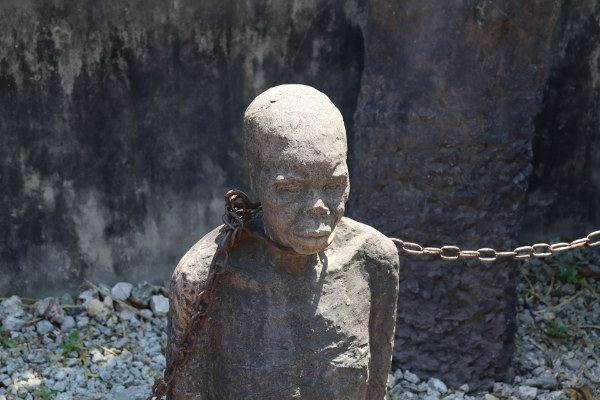
The enduring trauma and impact on the human psyche and memory of these inhumane experiences forms the foundation stones for the story. The depravity and brutality to which they were subjected stemmed from the concept of their being a sub-human species. For a black person to be killed, or maimed or caught or burned or jailed or whipped or evicted or stomped or raped or cheated – none of these violations would qualify as news in a newspaper. They were completely unremarkable. Because … whatever the manners, under every dark skin was a jungle.
124 Bluestone Road, Cincinnati, Ohio, is also central to the story; home to ex-slave Sethe, her mother-in-law Grandma Baby Suggs, and daughter Denver. Sethe herself is scarred mentally and physically by the experiences she’s suffered, and one day, when her previous master and three other men approach the house, she gathers up her three children, takes them to a shed, and using a handsaw, cuts the baby’s throat, in full view of her two young sons. Anything to save her from a fate worse than death. The furious ghost of the dead baby (who was not yet 2 years old) haunts the house thereafter. It becomes a ‘spiteful’ house.
The entire family are seriously affected by this tragedy, burdened by the memories and consequences, ostracised by the neighbours. So when a mysterious young woman, calling herself Beloved (the word carved on the baby’s headstone) appears one day, and establishes herself in the house with Sethe and Denver, we can’t be sure if she’s real or a metaphorical construct.
Whichever is the case, when Beloved re-enters the scene, emotions are turbulent and the family dynamics irretrievably affected. Denver is initially thrilled to have the companionship of a sister; but Beloved is obsessively attached to Sethe. An old friend Paul D who has moved in with the women becomes inextricably caught up in the repercussions.
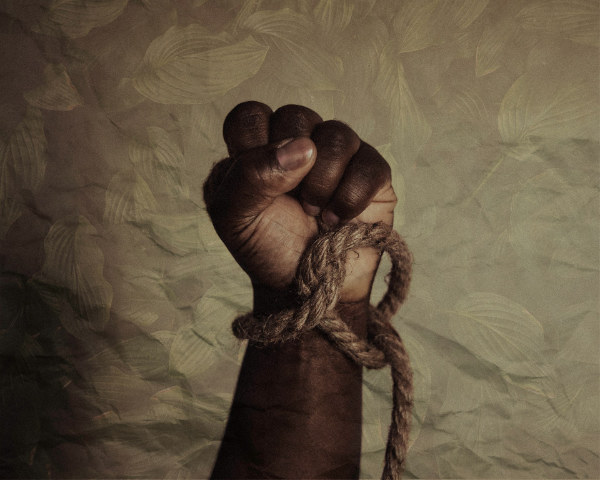
There are so many dimensions which potentially trouble the mind and conscience of the reader. One of the most poignant for me is the relationship of slave mothers with their children, some of whom were the result of repeated sexual abuse, many of whom died or were sold, never knowing who their fathers were.
She barely glanced (at the last of her children) when he was born because it wasn’t worth the trouble to try to learn features you would never see change into adulthood anyway. Seven times she had done that: held a little foot; examined the fat fingertips with her own – fingers she never saw become the male or female hands a mother would recognise anywhere. She didn’t know to this day what their permanent teeth looked like; or how they held their heads when they walked.
For a used-to-be-slave woman to love anything that much was dangerous, especially if it was her children she had settled on to love. The best thing … was to love just a little bit; everything, just a little bit, so when they broke its back, or shoved it in a croaker sack, well, maybe you’d have a little love left over for the next one.
It’s a difficult read.
Intellectually: the reader needs to work at understanding just what’s being conveyed, what’s happening in real life, what’s going on in the mind of these traumatised people.
Emotionally: listening to the voices of slaves grappling with the aftermath of barbaric treatment, and even after emancipation, struggling to adjust to a level of autonomy for which they are ill-prepared.
Morally: recognising that there are some dilemmas which can never be resolved or made sense of. There but for the grace of God …
… to get to a place where you could love anything you chose – not to need permission for desire – well now, that was freedom. 