The Glassmaker
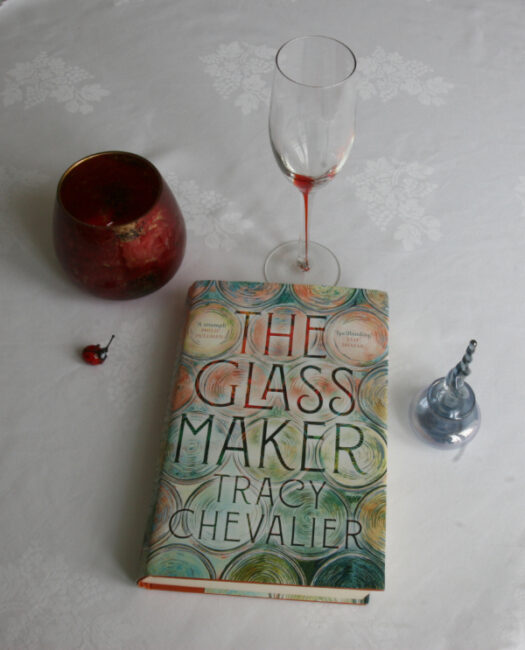 OK, cards on the table at the outset: I loved this book – The Glassmaker by Tracy Chevalier – but I also had reservations about it.
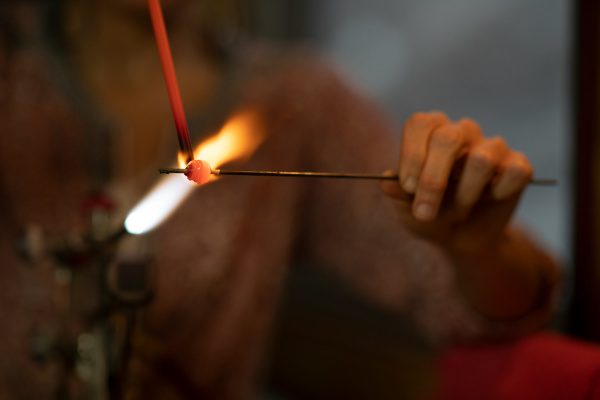
The story is set in Venice and Murano, both places I’ve visited and enjoyed, and Chevalier’s descriptions of the waterways and gondoliers and bridges and campaniles and Caffè Florian and floods and masks evoke their unique flavour beautifully and resonate strongly with me. I also love exquisite glassware (I’ve even tried my hand at glassblowing!), so I’m genuinely in awe of the skills involved, most ably captured in this book. I was predisposed, then, to romp through this tale.

The central character is Orsola Rosso, daughter of a long line of glassmakers, who’s forbidden from entering the profession because of her gender. But she hates the endless cycle of domesticity which becomes her lot, and flouts convention by turning to the creation of glass beads under the tutelage of a famous female beadmaker, Marietta Barovier (who really existed). She may not be allowed in the main workshop alongside the men and furnaces, but she can work with her own blowtorch and bellows equipment on a kitchen table in solitary peace. She has an outlet for her pent-up creativity.
Since the death of their father in a freak accident, her oldest brother, Marco, has become maestro in the creative workshop with its male hierarchy and immensely complicated designs and generations-long reputation. The siblings have always clashed, and Marco is characteristically scornful of his sister’s bead work, but Orsola persists, knowing that her income will help everyone in the lean times when the bigger goblets and mirrors and candlesticks are not selling as they once did.
Beads fill the spaces between things. They don’t get in the way. They are inconsequential, and women can make them because of that.
 The story traces her life from 6 to 60s, a vital part of a large family all struggling to deal with the fickle world of commerce, the loves and rivalries and loyalties of domestic life, the competition and successes and failures that accompany creative art forms. She herself loses the love of her life and marries a man who can never match up to his memory; she suffers numerous miscarriages; her glass work is variously lauded and dismissed. An indomitable soul who is forced to forgo her own passions in order to practically and emotionally support her family and fit in in a culture that limits her potential.

Thus far it ticked all my boxes. But what causes me to tone down my superlatives is the structure of the book. Alongside Orsola’s story we have the history of glassmaking in Murano and Venice through the centuries, starting in 1486 (when they were the epicentre of this artform) and ending in this century (with countries like Bohemia and China taking over production). This larger picture is portrayed at the beginning of each new chapter as a flat stone skimming the surface of the water of the Venetian Lagoon between the two places. Each time it dips into the water (about every 80 years) we have a résumé of significant historical events happening in the world at that time, but the characters have aged much more slowly. So their personal stories are continuous but they are grappling with quite different problems in the bigger world – plagues, floods, wars, unifications, technology … even Covid and climate change!
I’m hugely impressed by the meticulous research behind this work, with fascinating detail relating to glassmaking and life in Italy across the centuries. The writing is a joy to read, and grips the attention effortlessly. So perhaps it’s due to my own deficiency that I felt a glitch each time that stone touched the sparkling aquamarine waters of the Venetian Lagoon and we leapt forward almost a century – a sophistication too far for the brains of simple readers like me, maybe?
But I’d still heartily recommend the book.
‘Sex’ and ‘woman’?
Well, the highest court in the land – the final court of appeal – has now made its ruling.

In brief: the UK Supreme Court was tasked with deciding on exactly how a ‘woman’ and ‘sex’ should be defined. Even as I write I’m thinking … is this for real?! But I’m sure you’re fully aware of the huge controversy raging about the rights and legal protections of all those who claim to be female.
Well, yesterday these august people ruled that sex is binary and decided by biology: a woman is a person who was born biologically female. Changing one’s gender with a Gender Recognition Certificate does not give the same legal protections as those by right for biological women. Having said that, it’s important to note that the Equality Act 2010 still provides transgender people with protections against discrimination.
The court emphasised that this should not be seen as a triumph of one side over another, but just from listening to the sad deflated observations of those in the transgender community following the ruling, and the exuberant celebrations of women’s groups, it’s hard to believe that it will not be.
I need time to work this through, and I confess that I really don’t know what I think about some aspects of it, so much depends on one’s perspective. For now I simply put down a marker.
Adolescence
Well, I had to watch it!, didn’t I? Everyone’s talking about it … government ministers, schools, debating forums, all exploring its potential. Serious issues, conveyed through a clever script and amazing acting; important messages brought into the open, made accessible through fiction … exactly my bag.
Yep, I’m talking about the psychological crime drama, Adolescence, created by Steven Graham and Jack Thorne. Although it might have all the grim overtones of an actual true case/documentary, it’s neither of those things. It’s fiction; but fiction, inspired by the real life horror stories that too often nowadays bombard us through our screens and newspapers.
Told in four episodes, Adolescence features a 13-year old boy, Jamie Miller, (played by Owen Cooper) who’s arrested for the murder of a teenage girl at his school, Katie. From the outset we’re precipitated into the world of violent crime with a convoy of police vehicles approaching a house in the early hours of the morning, battering down the door, turning the rooms upside down, pointing guns at the family inside, and taking a lad barely into his teens into custody.
He’s such a young adolescent too: voice, facial features, skinny arms, nervous habits, fear of needles, all those of a child, and his repeated declarations of innocence convincingly match his looks. What father wouldn’t believe him? But the police have reason to doubt his story and before long Jamie is duly being processed by officers, lawyers, health care professionals, progressing from being alone in a dry police cell to a psychiatric detention centre.
The effect on the professionals of dealing with a juvenile is beautifully captured, from the arresting Detective Inspector, himself the father of a lad at the same school, to the psychologist, assigned to establish what kind of a person Jamie is prior to trial, who’s alone in a room with him listening to harrowing information and witnessing bouts of violent reaction. It falls to her to persist in spite of intimidation, to explore why Jamie thinks he’s so ugly not even the most desperate of girls will go out with him (at 13!); and to unravel the meaning of a range of emojis posted on his online platforms by the murdered girl. Does he even understand the permanence of death? There’s a very real sense given that everyone investigating the case is mystified by this cruel undercover world that is destroying the peace of mind of so many young people..
And then there’s the family – and every time a teenager is convicted of a major crime my thoughts always fly to the family of the perpetrator, whose lives are ripped apart mercilessly from the moment their child is arrested. In this case Jamie has parents and a sister, and we are given a tiny glimpse into their torment grappling with the unfolding horrors and the reaction of other people. Steven Graham himself plays the father and is superb at every stage, whether it’s being lost and bewildered in the police station initially, or doing his best to maintain a semblance of normality in the family, or going ballistic when youths taunt him and deface his van. But perhaps the most moving moments come when he is faced with the knowledge that his son has been exposed to toxic influences online, the dark world of misogyny and online radicalisation and the incel culture. His heart-rending words to his wife are wrung from the depths of his soul. His own father had beaten him as a child; ‘I wanted to be better … But am I?’ Together they agonise over the question: Should they, could they, have done more?
Extraordinarily each episode was shot in one continuous take –- what a challenge for the actors, especially the teenager playing the main role! Reviewers have spoken of the realism and immediacy created in this way, but I confess such niceties eluded me.
For me personally, the challenges went beyond the obvious questions relating to online corruption and the effects of bullying and cancelling, and relate to the use of this film. Would I wish this shocking footage to be shown to my children or grandchildren at a tender age? The uncontrolled behaviour of the school-children, the foul language, the violence, the images? But I accept that I’m of a different vintage, I’ve led a relatively sheltered life, though inevitably I’m becoming increasingly conscious of a very different reality today: pernicious influences are reaching our young people in the privacy of their own bedrooms and technological devices, with terrible consequences evident to us all. Something clearly must be done. The school teachers, police, psychiatrists, psychologists, social workers, and indeed parents of today are far better placed than I to know what needs to be done to shock society into action. Is this film the wake-up call we all need? It has certainly precipitated the debate.
The Historic Jesus
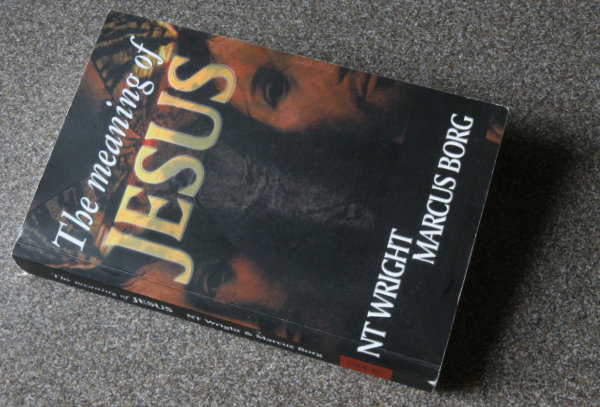
Early in the year I shared with you that I’ve set myself a challenge for 2025 to try to get to grips with who Jesus of Nazareth was in the historic context of his time and place. I ploughed through the first seven books in my pile with relative ease. NT Wright and Marcus Borg‘s The Meaning of Jesus gave me a harder run for my money, as I reported at the time.
Now it’s the turn of Kenneth Bailey. Wow! I’m sitting at the feet of a master of Middle Eastern culture with impeccable credentials; a man who grew up in, as well as lived and worked in the area much of his life (1930-2016), not only a prolific author and lecturer in Middle Eastern Studies, but also an ordained Presbyterian minister to boot!
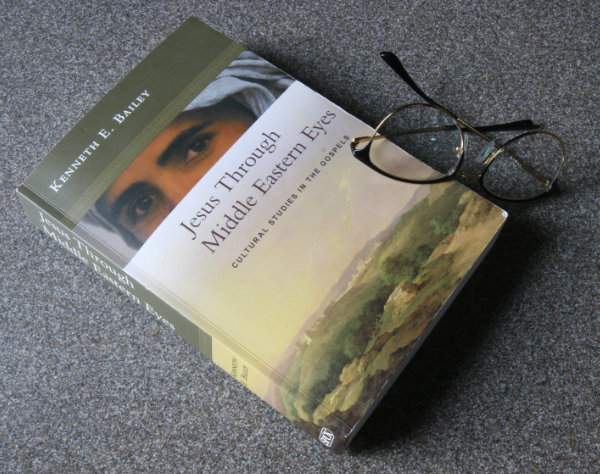
Jesus through Middle Eastern Eyes – which I’ve just finished reading – is in a league of its own, I suspect. Bailey begins rather provocatively by taking apart the ever-popular oh-so-familiar Christmas stories of Jesus’ birth. If you’ve swallowed the old traditions from your youth up – donkeys and inn-keepers and precipitate births etc – prepare to have the rug unceremoniously whipped from beneath your feet. It’s a clever way of grabbing our full attention without doing too much damage. Though I’d heard many different challenges to the birth stories before, somehow I found Bailey’s perspective put me in the mood to have all my preconceived ideas on other topics and my supposed knowledge challenged. I could see from the outset that Western eyes and minds in general have obscured important aspects of Jesus’ life and ministry – for most of us. But if we’re to understand who Jesus really was, and what he was all about, we need to take off those Western glasses and get the dust of the Middle East in our eyes. And boy, he’s the man to guide is through that journey.
He writes beautifully and so compellingy. Everything is clearly organised and laid out. And though there’s plenty of evidence of scholarship and wide reading in the references and footnotes, he doesn’t allow his great learning to bog down the text. Instead he focuses on one topic at a time, drawing out clear points of biblical exegesis and the significance of what these ancient books have to tell us. He’s selective: covering Jesus’ birth, the Beautitudes, the Lord’s Prayer, dramatic actions of Jesus, and his relationship to women, with more than half the book devoted to the parables.
I found it both fascinating and illuminating. How could I ever have assumed we Westerners could adequately interpret these books without insider reference to the ancient and foreign culture in which it was all enacted? With his own extraordinary background, this author has the skill to understand Middle Eastern texts and interpreters that very few other scholars could attempt, and in his hands the stories come alive and assume proportions and details and meaning hitherto unseen. The book seems to me to end rather abruptly but perhaps that simply leaves the reader looking for more.
A first! … maybe …
 Well, after all these years of talking and debating and campaigning it has finally happened: the Isle of Man has just become the first place in the UK to make Assisted Dying legal.
However, it’s by no means a done deal yet. Right now it just means the Manx parliament has agreed to pass this law allowing terminally ill adults with legal capacity, who have lived on the island for a minimum of five years, are registered with an Isle of Man GP, and who now have a life expectancy of 12 months or less, to end their lives, subject to the approval of two independent doctors.
But that’s not the end of the matter by any means. Right now, it’s essentially theoretical. Before this legislation can become operational, it has first to go for Royal assent. If that’s granted, it could become law later this year and an assisted dying service could be in place by 2027 – both these steps will involve a lot of work and discussion and close scrutiny. And there are no foregone conclusions.
Oh, and there’s another complication: three quarters of doctors who responded to an Isle of Man Medical Society survey in 2023 said they were opposed to assisted dying, and a third would consider leaving the island if the legislation were introduced. Now that feels to me like quite an obstacle.
And now, in the same week, we hear that the proposed bill for England and Wales, which has met with enormous problems since it passed the first stage in the Commons last year, has been kicked into the long grass after its Labour sponsor, Kim Leadbeater, proposed delaying it for two years until after the next election. There is a distinct possibility it would be dropped altogether by a different government.
I’m sure, you like me, have heard plenty of Joe/Jessie Bloggs stating their absolutely views with supreme confidence, but actually finding an ethical, safe, workable method of implementing change, and enshrining it in law, is fraught with problems. Not surprisingly really; after all, life itself is sacred, and feelings run high on both sides of the arguments.

Neurodivergence
This week is Neurodiversity Celebration Week, so it seems appropriate to share my experience at a conference down south which I attended this weekend. I was blown away by a brilliant workshop on neurodivergence. The very well-informed leader combined knowledge with real understanding and personal experience, bringing the issues vividly to life. I actually know quite a number of people who are neurodivergent (approx 1 in 7 of the population), but I learned a lot and hope to be more aware and sensitive in future.
The experience also made me reflect on the value of story in helping us to understand different life experiences. The course facilitator used examples from her own home life to excellent effect, but two fictional dramas also sprang to my mind, both of which highlight autism. (Click on the pictures for the official trailers)
 The A Word centres on a little boy – Joe Hughes – and his family adjusting to life with his differences.
 And a Belgian/British detective drama, Patience, features an older main character – Patience Evans – who utilises her unique skills to solve crimes.
With facts and figures and lists of behaviours fresh in my mind, I’m valuing in a new way the attention to detail script-writers and actors bring to the table.
If you’ve met one individual with autism,
you’ve met one person with autism.
(Dr Stephen Shore)
Obviously no two people with autism are the same but some of the main features emerge clearly through these dramas: obsessive tendencies, deep special interests, sensitivity to noise, fear of criticism or being wrong, difficulty interpreting body signals and struggles with interaction, thinking outside the box, obsession with rules, love of puzzles, brutal honesty. And in both productions, the potential to misunderstand and compound the problems and get it so wrong, are highlighted.
I take my hat off to the teams behind such works of fiction for their sensitivity, awareness and courage tackling such tricky topics, and highly recommend both of these programmes.
Between Sisters
 It’s a long time since I read and reviewed Kristin Hannah‘s bestseller, The Nightingale. But it’s one of those exceptionally accomplished works that haunt you long after you close the covers. And such masterpieces make one wonder, how can this author possibly follow that?!
So, I wasn’t surprised to discover that Between Sisters didn’t reach such dizzy heights.
Meghann Dontess and Claire Cavenaugh are now polite (sometimes!) strangers who share a mother, a blood type and an ugly childhood. They grew up in a broken-down trailer, abandoned at a vulnerable age by their shallow actress mother, who is obsessed with celebrity and image. She has since lurched from husband to husband, making no move to be a parent beyond an occasional phonecall.
Meghann has emerged from her early years and troubled adolescence to become a successful lawyer, living alone in an expensive condominium in downtown Seattle, surrounded by the trappings of wealth and achievement. She has no desire to ‘settle down’, but has developed an unhealthy penchant for one-night stands with younger men. Now 42, lonely and scared of the future, she’s receiving psychiatric counselling, which highlights issues she had with her younger sister, Claire, when Meghann was 16.
Claire (35) lives more simply as assistant manager on her father’s 16 acre holiday resort, and loves her job. She shares her tiny cottage with a hotchpotch of renovated secondhand furniture, and her daughter Alison (5), lovingly supported by Claire’s biological father, Sam. Unlike Meg, Claire has a strong social metwork that includes a sisterhood of close friends.
But when she’s told that Claire is about to marry a country singer she’s known for a matter of mere weeks, Meghann rushes to her rescue. Thrown together in such circumstances after twenty years apart, the sisters discover truths about themselves as well as each other, and when tragedy strikes, they together fight for a future.
For me, the ends are tied up rather too neatly, but regardless of its relative literary merits or demerits, the themes of love and abandonment, estrangement and forgiveness, mercy killing and family crises, would make this a potential candidate for a book club discussion.
Twisted
What to choose for my break from serious study? Ahah! Jonathan Kellerman! Twisted. 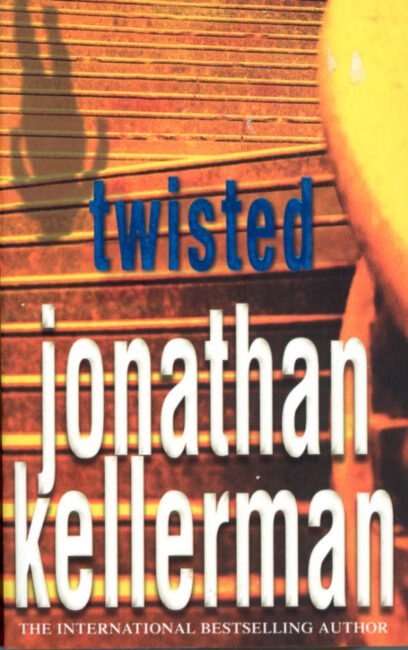 That’ll do nicely. Kellerman’s a child psychologist by background and an acknowledged master of psychological thrillers, so it’ll grip my attention and require close concentration to stay with the plot. The thinking behind criminal acts rather than the actual killing intrigues me.
And did it ever?! A huge cast of characters; red herrings; multiple cases; twists and turns and subplots aplenty; suspense added with a concrete deadline setting the parameters and count down for the chase.
Detective Petra Connor is a busy hands-on homicide officer in California juggling assorted cases when Isaac Gomez, a young research prodigy from an underprivileged background, is assigned to her. Soon after his introduction to police procedures and files, he tells her he’s found an interesting phenomen linking six unsolved murders that occurred over six years: all were committed at around midnight on June 28th. Initially rather sceptical, Petra comes to recognise Isaac’s uncanny ability to think analytically, and together they begin to unravel new material, pursuing witnesses and acquaintances of the victims, all of whom were killed by a massive blow to the back of the head with a blunt instrument, so violent that brain matter is splattered over the scene of the crime. A picture begins to build of a cold and evil mind at work, calculating and orchestrating a pattern of annual murders.
But why June 28th? Isaac enlists the help of librarians who know him well to search the archives for possible enlightenment, while Petra interviews and follows and sifts the people and facts connected with the six cases, both only too aware of the days ticking down to June 28th, and in the process ruffling feathers as they expose negligence and carelessness and perhaps even cover-up on the part of the officers initially assigned to these murders. But not even being suspended from the force will stop Petra doing all she can to save the life of another innocent person on June 28th.
The suspense holds until the very last chapter when an unexpected twist reveals the identity of the real killer. A masterfully plotted tale. And just what the doctor ordered!
Progress update on the big challenge
A month ago I shared the information that I had set myself a challenge to search for understanding of the real Jesus. I showed the first pile of books I planned to read.
 Well, I can now report real progress! Wahey!! All these books have now moved to the have-been-read shelf. And a substantial pile of knitting for refugees is filling out a polythene sack!
I confess I felt I was drowning for a while, but persistence has paid off and things are coalescing to give me a clearer – no, perhaps ‘less-muddy’ picture would be more accurate. So at this point in my search, I want to pay tribute to the many writers who have attempted to put down their thoughts and scholarship on what is an immensely difficult and multi-layered issue.
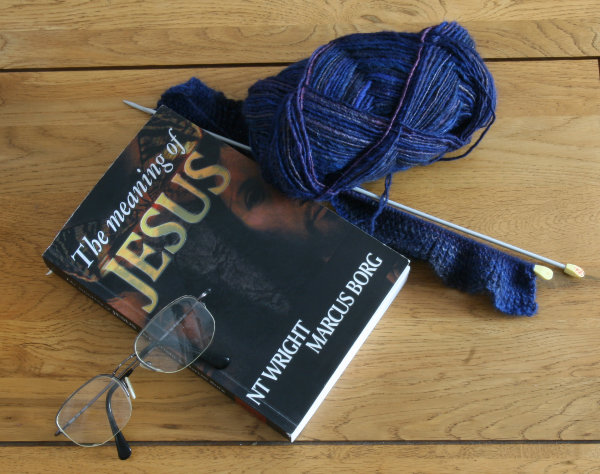
In particular one book stands out for me and calls for a specific mention: The Meaning of Jesus by NT Wright and Marcus Borg. Both New Testament scholars, they have excellent credentials for tackling this topic, with impressive lists of awards, appointments and books to their credit. NT Wright is an English Anglican; Marcus Borg was an American Liberal Christian (he died in 2015). Real authorities then, huh?
But not so fast! In this book they have together presented differing views on the historicity and meaning of Jesus of Nazareth. And I mean radically different! On pretty much every aspect: his origins, his birth, his divinity, his foreknowledge, his sayings, his resurrection, his intentions … Mightily confusing for us lesser mortals sitting at their feet. Who is right? They can’t both be.
But they have both challenged me greatly. We are too used to turning to an authority on a subject and quoting them to substantiate a fact or a viewpoint. These two men ask us to enter into their thinking and work it out for ourselves. A work in progress.
However, what impressed me most is their humility and deference each to the other. Less qualified and generous minds too frequently fail to show respect or tolerance for alternative interpretations. But in the struggle to understand matters at the interface between God and humankind, it’s fitting that all should acknowledge they see through a glass but darkly, and encourage fellow travellers to keep thinking and exploring. As they do.
As I’ve said before, I’ve spent years re-examining my own set of beliefs and refining, confirming, revisiting, discarding. So I love the idea conjured up by Wright: It’s time that the old scholars’ myths were given a decent burial! I’ve certainly buried a few in the light of their exposition.
On now to the work of another towering figure who has a wealth of personal experience living in the land where the historic Jesus walked and talked: Kenneth Bailey – Presbyterian, lecturer and author; master of Middle Eastern culture. But first I’m going to take time out to read an undemanding novel to give my grey cells a bit of a holiday!

The Lady of the Rivers
I’m sure Philippa Gregory needs no introduction: historian and mistress of fiction securely anchored by her meticulous research. She’s perhaps best known for her novels set in Tudor times, but she has also turned her attention to the powerful family who preceded the Tudors, the Plantagenets, and I’ve been completely absorbed in one of these: The Lady of the Rivers.
 As usual the central character is a woman, Jacquetta, first lady of Luxembourg, about whom very little is known from the records which tell history through the lives of prominent men.
It’s the fifteenth century, the dangerous times of the Wars of the Roses, where rivalries between families in England and with France, are raging. Reputations, honours, lives, are won and lost upon a whim. Monarchs rise and fall, loyalties and titles fluctuate with them, and religion, spiritualism and magic play a central part in the lives of these medieval people.
From a young age Jacquetta is inspired by the family legend of their ancestor Melusina, the water goddess. She is aware herself of having mysterious other-worldly sensations and glimpses into the future, although as she says, these things are too thin for speech. Only time can demonstrate how accurate such predictions were, and throughout her life she identifies events which she foresaw in her youth. But the penalties for alchemy and witchcraft are severe, and she is at pains to downplay her gift and always to use it for good, never ill.
Knowledge is just another thing to conceal, these days.
These are brutal times and she’s only fourteen when she’s forced to stand with her aunt, calmly watching Joan of Arc being burned at the stake, a girl with whom she had established a close rapport, and who shared her experience of visions.
We stand hand-clasped, our faces quite blank, as if this were not a nightmare that tells me, as clearly as if it were written in letters of fire, what ending a girl may expect if she defies the rules of men and thinks she can make her own destiny. I am here not only to witness what happens to a heretic. I am here to witness what happens to a woman who thinks she knows more than men.
 Then at seventeen she is required to marry the very man who ordered the burning to death of the Maid, Joan: the newly widowed John, Duke of Bedford, now in his forties, Regent in France, son of Henry IV. This alliance makes Jacquetta an English duchess, the first lady after the king’s mother in England; the first lady bar none in France.
On the eve of her wedding she learns that it will be her duty to retain the friendship of all his allies who don’t support this rapid marriage, but whom he needs to fight alongside him. But it’s not until the morning after the wedding that she learns that the Duke hasn’t chosen her for any reason other than her gift of forseeing. He wants her to help him create a new rich and peaceable world; to manufacture gold and silver, even life itself. And for this purpose he is going to keep her a virgin. Their marriage lasts two years until he dies.
However, Jacquetta, deprived of love and passion, has been falling in love with her husband’s handsome right hand man, Richard Woodville, and they marry in secret less than a year after she is widowed, before she can be betrothed to someone not of her choosing. This rebellious act results in her fall from grace and the forfeiture of her wealth and property, but the couple are blissfully happy. They quickly produce their first daughter, Elizabeth, to be followed by thirteen other children.
Before long the young king forgives them and they are summoned back to court. But the trial and burning at the stake of the very woman who taught Jacquetta all she knows about herbs and provided the potion to help her conceive – a herbalist now declared a witch –strikes dread into their souls. Now everyone who has been studying the stars or reading books or testing metals is under suspicion and the Woodvilles slink back to the country and their children for safety.
But then Jacquetta is chosen to go to France to bring back the fifteen year old Margaret of Anjou to be married to the timid ultra-religious twenty-three year old king Henry VI. Jacquetta quickly becomes chief confidante and most favoured lady in waiting and true friend to the new young queen of England. It’s not an easy role. The weak king and his more dominant queen are inexperienced, spoilt and badly advised. They make serious mistakes. Both Jacquetta and Richard long to be free of all the intrigue and fear and suspicions of court, but feel protective of their young monarchs who so badly need sound advice.
They make enemies every time they address parliament. The queen rides through the streets of London as if she hates the very cobbles.
Things deteriorate still further when the king develops a mental illness that renders him incapable of making decisions or even acknowledging Margaret’s only son Edward as his heir. The people start to riot. Law and order are overturned. Again and again Richard is rewarded for loyalty, bravery and leadership, rising through the ranks of titles and prestigious commands, but the Woodvilles pay a high price for their allegiance, and in the end when the Lancasters are thoroughly routed in a fearsomely bloody battle in the snow, they surrender to a new king, Edward of York.
The book ends with the Woodvilles being reduced to the level of a country squire and his wife, but history tells us that Jacquetta rose again to become a leading lady at the royal court following the marriage of her eldest (widowed) daughter Elizabeth to King Edward IV.
It’s a brilliant novel, beautifully conceived, intriguingly told.